
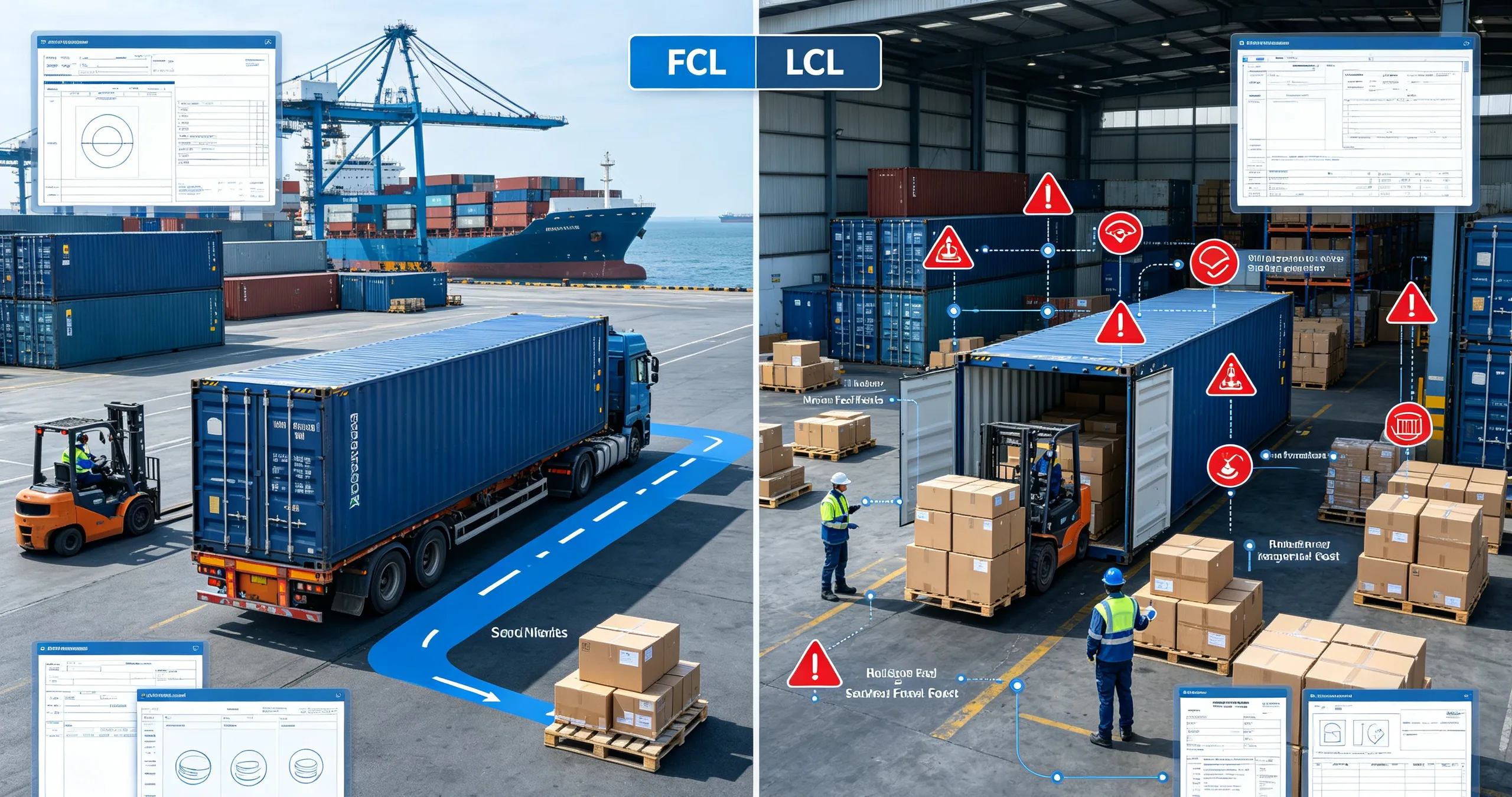
China freight forwarding costs consist of port local charges, ocean freight, surcharges, and destination fees. Understanding every item helps cross-border sellers avoid hidden charges and budget accurately.
What are the core components of China freight forwarding costs?
All China-based forwarding fees fall into four fixed categories, covering the entire shipping process from domestic pickup to overseas delivery. These standardized charges apply to both full container load (FCL) and less than container load (LCL) shipments, the two mainstream ocean freight modes for cross-border logistics. FCL refers to exclusive container use for large-batch cargo, while LCL means multiple shippers share one container for small-batch shipments.
The four core cost modules include origin local fees, base ocean freight, variable surcharges, and destination port charges. Many new sellers only compare base freight rates and ignore auxiliary fees, which is the main cause of budget overruns and unexpected logistics costs.
What origin local fees are charged for China outbound shipments?
Origin local charges are fixed domestic fees generated before cargo departs Chinese ports, with stable pricing for long-term shipments.
• Booking Fee: A basic service fee for reserving vessel space from shipping carriers, mandatory for all FCL and LCL orders.
• THC (Terminal Handling Charge): Standard port operation fees for container loading, unloading, and yard management at Chinese terminals (Logistics 123, July 2026).
• DOC (Document Fee): Charges for bill of lading production, document verification, and customs file arrangement.
• Customs Declaration Fee: Professional service fees for formal China export customs clearance and declaration filing.
• Trucking & Warehousing Fee: Costs for factory cargo pickup, domestic transportation, and temporary warehouse storage before shipment.
What is base ocean freight and how is it calculated?
Base ocean freight is the core charge for cross-border sea transportation, fluctuating with shipping seasons, carrier capacity, and oil prices. FCL shipments adopt fixed container-based pricing, while LCL shipments are calculated by cargo volume (CBM, cubic meter), the standard unit for international logistics volume measurement.
Off-season freight rates remain stable, while peak seasons (September to December annually) witness obvious price increases due to tight cabin supply. This fee is the most intuitive part of forwarding quotes but cannot represent the total logistics cost alone.
What common variable surcharges do sellers need to prepare for?
Variable surcharges are dynamic fees adjusted by carriers based on market and policy changes, which easily become hidden costs for inexperienced sellers.
|
Surcharge Item |
Full Name & Definition |
Charge Rule |
|
BAF |
Bunker Adjustment Factor, fuel surcharge to offset international oil price fluctuations |
Dynamic adjustment with real-time oil prices |
|
CAF |
Currency Adjustment Factor, exchange rate fluctuation compensation fee |
Adjusted monthly based on currency exchange rates |
|
PSS |
Peak Season Surcharge, peak cabin shortage premium |
Charged from September to December every year |
|
CGS |
Congestion Surcharge, port congestion emergency fee |
Temporary charge for busy port terminals |
What destination fees will be incurred after cargo arrives overseas?
Overseas destination fees are unavoidable for China outbound cross-border shipments, varying slightly by country and port. Main charges include destination THC, port storage fees, customs clearance fees, tariff and tax fees, and last-mile delivery fees for Amazon FBA or warehouse inbound shipments.
For delivered duty paid (DDP) shipments, the forwarder integrates all destination taxes and service fees into the quote; for delivered at place (DAP) shipments, overseas clearance and tax fees are borne by the buyer. Sellers must confirm fee inclusion scope to avoid secondary charges.
FAQ
Q1: Why do forwarding quotes from different providers differ greatly?
A1: Low quotes usually only contain base ocean freight, excluding local charges and surcharges. Complete quotes cover all four cost modules, so sellers should compare full-package costs instead of single freight rates.
Q2: Are origin local fees fixed all year round?
A2: Mostly stable. Only individual terminal handling fees are adjusted slightly with policy updates, without drastic seasonal fluctuations like ocean freight.
Q3: Do LCL shipments have more hidden fees than FCL?
A3: Yes. LCL involves cargo consolidation and deconsolidation operations, with more auxiliary service fees. FCL has transparent fees and fewer intermediate links, suitable for large-batch shipments.
Q4: How can sellers effectively control forwarding costs?
A4: Match shipping modes by cargo volume, avoid peak-season shipments, confirm full-package quotes in advance, and choose compliant forwarders with transparent fee details.
Final Thought
China freight forwarding costs are a systematic combination of fixed and dynamic fees, not a single freight rate. Blindly pursuing low base freight will lead to hidden cost risks and disrupt inventory budgets. Mastering the composition of port fees, surcharges, and destination charges helps cross-border sellers accurately evaluate logistics plans and improve overall profit margins.
As a professional China logistics provider, Easy China Warehouse (ECW) offers transparent full-package forwarding services for FCL, LCL, and FBA inbound shipments. We provide detailed fee breakdowns for every order to avoid hidden charges.
Contact us for customized shipping quotes and cost optimization solutions: [email protected]
Follow our blog for practical cross-border logistics cost control tips and industry updates.
Contact Us