
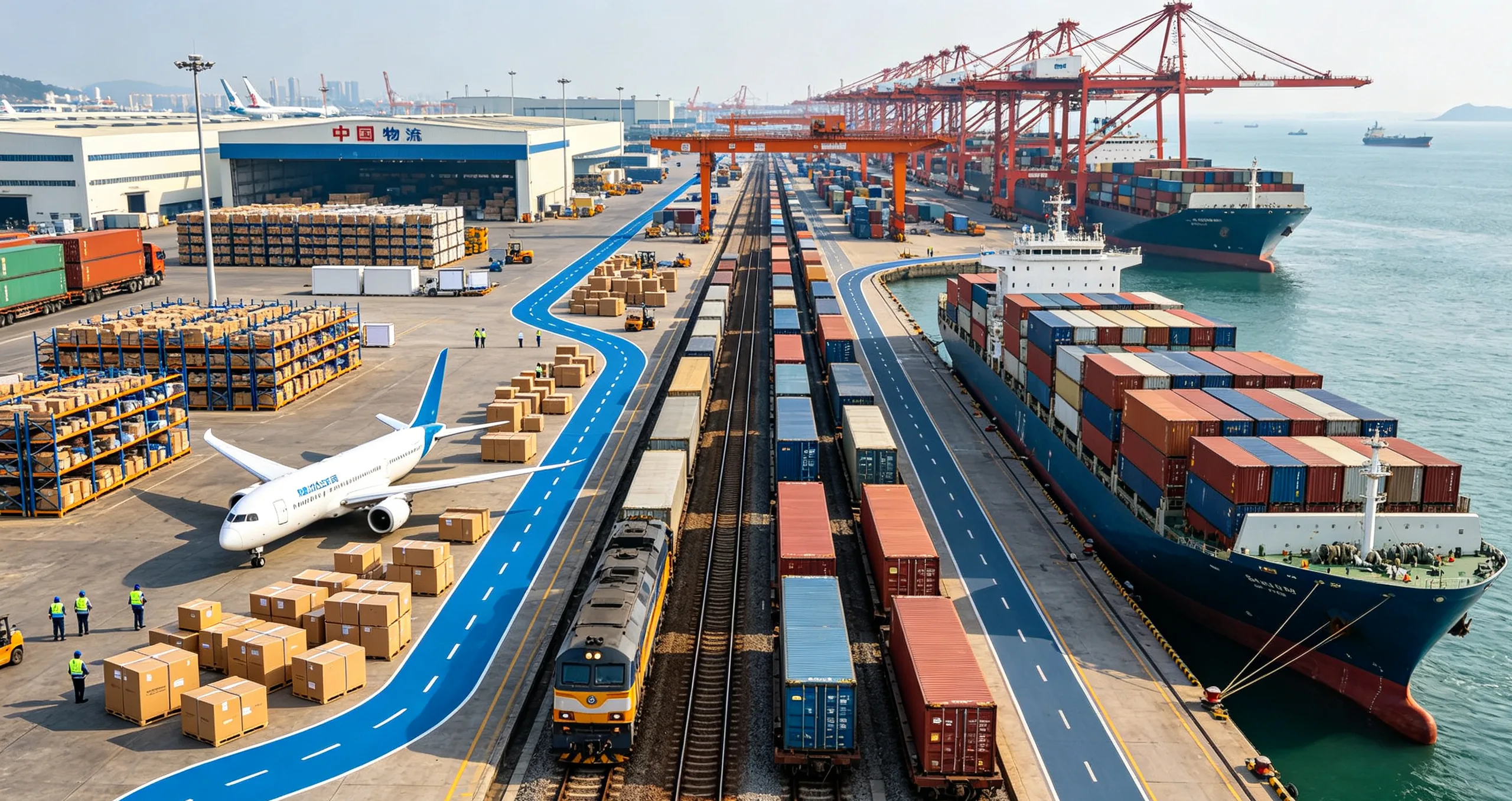
Shipping transit times from China vary by transport mode and destination. Air freight, sea freight, rail, and express delivery each have fixed, verifiable delivery windows for global cross-border shipments (2026 industry data).
What are the four main shipping modes from China?
All China outbound cross-border shipments rely on four mainstream transport solutions, each with distinct speed, cost, and application scenarios for Amazon FBA and DTC sellers. Express shipping refers to door-to-door courier services for urgent small parcels. Air freight is bulk air cargo for medium-sized inventory. Rail freight covers stable Eurasian land transport. Sea freight includes full container load (FCL) and less than container load (LCL) ocean shipping for large-volume goods.
FCL means exclusive container usage for single-client cargo, while LCL allows multiple sellers to share one container to cut costs. These two ocean freight terms are the most common options for bulk cross-border inventory replenishment.
How fast is express shipping from China to global countries?
International express shipping is the fastest China outbound solution, suitable for urgent restocks and small-batch DTC orders. It supports full door-to-door delivery with streamlined customs clearance.
|
Destination |
Express Transit Time |
Applicable Scenarios |
|
USA / Canada |
3–7 business days |
Urgent FBA restock, sample delivery |
|
European Countries |
3–6 business days |
Time-sensitive DTC orders |
|
Southeast Asia |
2–4 business days |
Fast regional parcel delivery |
|
Australia / Middle East |
4–8 business days |
General urgent shipments |
How long does air freight shipping from China take?
Air freight balances speed and cost, ideal for medium-batch inventory replenishment that is not extremely urgent. It requires airport pickup or warehouse delivery after customs clearance, without full door-to-door coverage by default.
Standard air freight takes 7–12 business days to the US and Europe, while premium direct flights can shorten the cycle to 5–7 days (China Freight World, July 2026). Southeast Asia air freight only needs 4–6 days due to short flight routes. This mode is widely used for Amazon seasonal pre-stock and peak-season inventory supplementation.
What is the standard transit time for sea freight from China?
Sea freight is the lowest-cost solution for large-volume shipments, with the longest but most stable transit cycle. Time differences mainly depend on destination port locations and direct/transship routes.
|
Ocean Route |
FCL Transit Time |
LCL Transit Time |
|
China to US West Coast |
14–18 days |
18–22 days |
|
China to US East Coast |
28–32 days |
32–38 days |
|
China to Europe |
28–35 days |
35–42 days |
|
China to Southeast Asia |
5–12 days |
8–15 days |
|
China to Australia |
18–25 days |
22–28 days |
LCL shipments require additional consolidation and deconsolidation procedures, so they always take 4–7 days longer than FCL shipments on the same route (SINO Shipping, August 2026).
How long does China-Europe rail freight take?
Rail freight is a stable alternative between air and sea freight, exclusively serving Eurasian routes. It avoids sea port congestion and air freight high costs with a fixed transit cycle.
China to Germany, France, and other core European countries takes 15–25 business days. This mode is suitable for sellers with medium lead-time requirements and large inventory volumes, effectively avoiding seasonal ocean freight delays and air freight budget pressure.
What key factors affect shipping transit time?
Published baseline shipping times do not include unpredictable delays caused by external factors. Four core variables will change actual delivery cycles for cross-border shipments.
First, seasonal peak periods from September to December cause cabin and container shortages, extending transit time by 3–7 days. Second, customs inspection intensity from CBP and EU customs will delay clearance progress. Third, port congestion and transshipment schedule adjustments affect ocean freight stability. Fourth, incomplete declaration documents will trigger manual reviews and hold cargo.
FAQ
Q1: Which shipping mode is most stable for Amazon FBA replenishment?
A1: FCL sea freight and China-Europe rail freight have the highest stability with fixed schedules. Express and air freight are easily affected by peak-season cabin tension.
Q2: Why do LCL shipments take longer than FCL on the same route?
A2: LCL requires cargo consolidation before departure and deconsolidation after arrival, adding 4–7 days of operational time compared to direct FCL shipments.
Q3: Can peak-season shipping delays be avoided?
A3: Delays cannot be completely eliminated. Sellers can advance shipment schedules by 7–10 days and choose direct routes to reduce risks.
Q4: What is the fastest way to ship bulk inventory from China to Europe?
A4: Premium direct air freight (5–7 days) is the fastest bulk solution; new European polar express sea routes can shorten ocean transit to about 20 days (China Daily, July 2026).
Conclusion
Shipping time from China to global countries follows fixed mode-based timelines: express for urgent orders, air freight for medium batches, rail for stable Eurasian replenishment, and sea freight for low-cost large-volume shipments. Sellers must match shipping modes with inventory cycles to avoid stockouts or overstock.
Easy China Warehouse (ECW) provides mode-matched global shipping solutions, including FCL, LCL, air freight, and express services. We offer accurate transit time assessment and schedule planning for Amazon FBA and Shopify DTC sellers.
Contact our logistics team for customized shipping plans and accurate delivery scheduling: [email protected]
Follow our blog for updated 2026 cross-border shipping timeline data and risk control tips.