
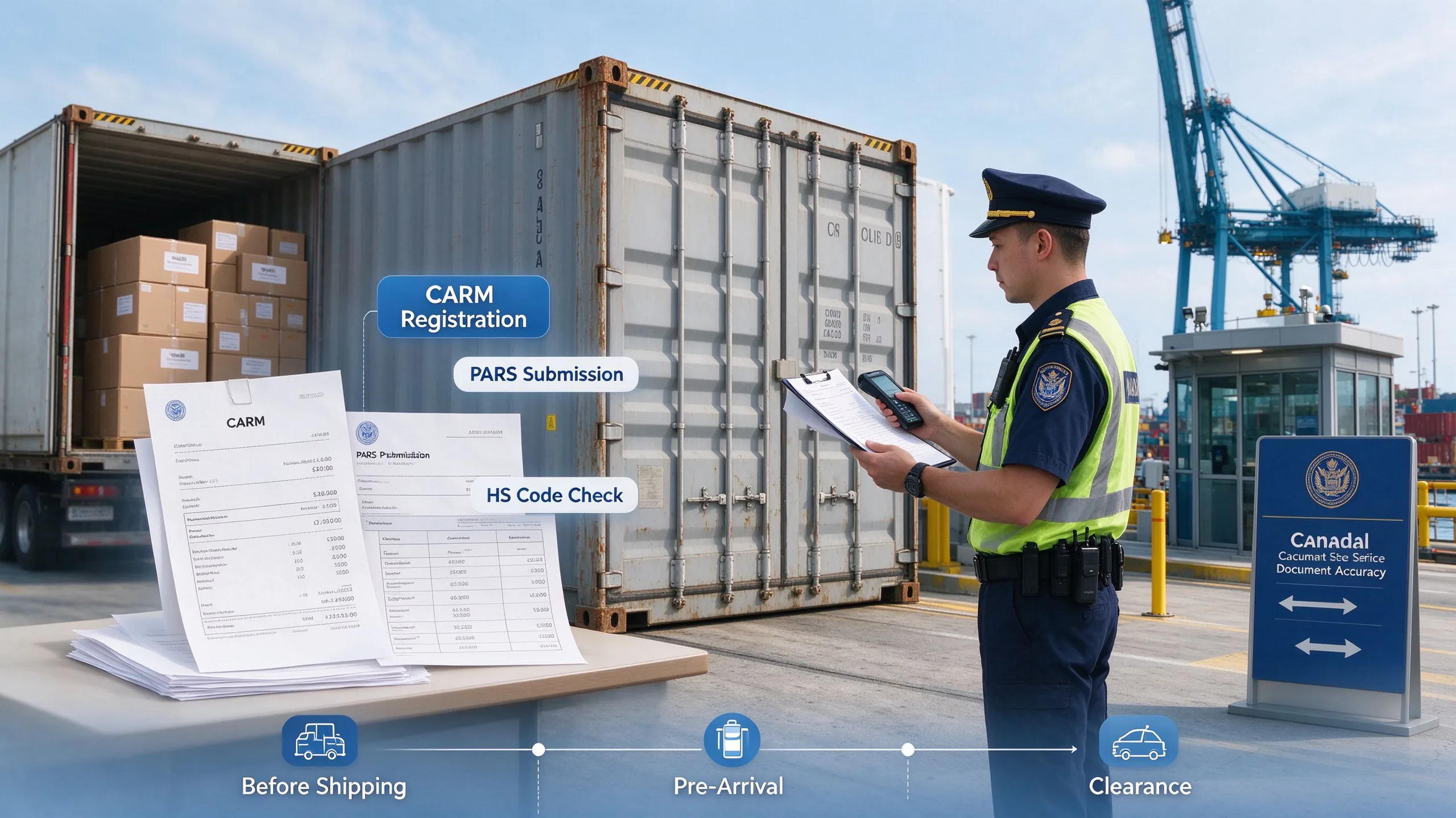
Complete CARM registration, accurate document filing and pre-arrival PARS submission can stop CBSA cargo holds and cut clearance waiting time sharply.
What system setup causes most Canada customs delays?
Unfinished CARM registration is the top reason for cargo detention for China-to-Canada commercial shipments. CARM stands for CBSA Assessment and Revenue Management, the mandatory import portal for all commercial importers starting May 2025 in Canada. Importers must register for a CARM Client Portal account and delegate authority to their customs broker before goods arrive. If this step is incomplete, CBSA cannot process release paperwork, and containers will sit at port with daily demurrage fees. You also need a BN15 importer account from Canada Revenue Agency. No broker can complete this registration on your behalf. This rule applies to sea freight, air freight and courier parcels alike. Many Amazon FBA and Shopify sellers face 3–7 day holds only because they skipped CARM setup before shipment departure. If you regularly send inventory to Canadian Amazon warehouses, read our guide on shipping to Amazon FBA.
How to make commercial invoices and HS codes error-free?
Vague product descriptions and wrong HS tariff codes trigger automatic CBSA inspections. You cannot write generic terms such as “electronics” or “hardware” on invoices. Every line item needs full details: material, model, function and unit size. For example, “100% cotton woven men’s short-sleeve shirt” instead of “clothes”. The HS code is a 10-digit tariff classification number. Never guess HS codes to reduce duty rates. Misclassification leads to AMPS administrative fines from CBSA. Keep purchase orders, payment records and supplier contracts to prove declared unit value. Under-declared value always triggers secondary inspection. All invoice data must match exactly with eManifest and PARS pre-arrival filings. Any mismatch between cargo manifest and invoice will pause clearance immediately.
What pre-arrival filing rules do you need to follow?
Sea freight shipments must finish PARS (Pre-Arrival Review System) filing 72 hours before vessel arrival at Canadian ports. PARS is the electronic pre-clearance system for ocean cargo. Carriers submit ACI (Advance Commercial Information) via eManifest before arrival. If you miss the 72-hour window, your shipment will not pass pre-screening and will go directly to secondary inspection. Air and courier shipments follow the CLVS (Courier Low Value Shipment) program for small parcels under CAD 2,500. Even low-value parcels require full importer BN number and accurate origin marking. Goods marked “Made in China” without exceptions. Missing country-of-origin labelling causes physical cargo inspection and multi-day delays.
What special permits and certificates do regulated goods require?
Many product categories need extra government approval before entering Canada. Food, plant and animal goods require CFIA (Canadian Food Inspection Agency) inspection certificates. Electronic products need Health Canada safety certification. Textiles, steel and solar panels from China may face anti-dumping duty reviews starting in 2026. You must confirm regulatory requirements via the AIRS database before booking cargo. If you ship restricted items without permits, CBSA will hold the goods until documents are submitted, or order full cargo seizure. Even small Shopify parcel shipments are subject to these rules. No exception applies for e-commerce small orders.
Side-by-side delay risk comparison table
|
Shipment Type |
Main Delay Trigger |
Typical Hold Duration |
Preventive Action |
|
Ocean FCL/LCL |
Unapproved PARS filing, CARM missing |
3–14 days |
Submit PARS 72h pre-arrival, finish CARM delegation |
|
Air Freight |
Incorrect HS code, incomplete invoice |
2–5 days |
Verify HS code, align manifest and invoice data |
|
Courier Parcel (Shopify/FBA) |
Missing BN number, vague description |
1–3 days |
Fill full importer BN, add detailed product info |
|
Regulated Goods |
Missing CFIA or Health Canada permits |
7–30 days |
Check AIRS database and apply for certificates before shipping |
How to avoid inspection delays during peak shipping seasons?
Peak season runs from October to December every year. CBSA inspection volume rises sharply, and routine checks turn into multi-day holds. You can take three fixed measures to shorten waiting time. First, finish all pre-arrival electronic filings at least 5 days before vessel arrival, not just the minimum 72 hours. Second, separate high-risk SKUs such as metal hardware and electronics into independent shipments, so one inspected item does not hold up the whole container. Third, choose Vancouver as the first port of entry instead of eastern ports; western CBSA offices have shorter inspection queues for China-origin cargo. You should also avoid booking shipments that arrive right before public holidays, as document processing stops completely during statutory holidays.
Frequently Asked Questions
Q1: Can customs brokers register my CARM account for me?
A1: No. Only the importer can create the CARM Client Portal account. Brokers only receive clearance authority after you complete delegation inside the portal.
Q2: What happens if PARS data does not match the commercial invoice?
A2: CBSA will put the shipment on hold until you resubmit corrected documents. The hold usually lasts 2–4 business days and generates port storage fees.
Q3: Do low-value Shopify parcels under CAD 2,500 still need CARM setup?
A3: Yes. All commercial shipments, regardless of value, require an active CARM account starting in May 2025. Low-value exemptions only apply to duty calculation, not system registration.
Q4: Why do China-origin steel goods get extra CBSA reviews?
A4: Canada maintains anti-dumping duties on selected Chinese metal products in 2026. CBSA will conduct targeted audits to confirm origin and classification, which adds 7–14 days of clearance time.
Q5: How long does a physical container inspection normally take?
A5: CBSA completes container examinations within 24 working hours excluding weekends. If CFIA secondary checks are required, the timeline extends to 3–7 working days.
Conclusion
Most Canada customs delays for China shipments come from incomplete CARM setup, inaccurate paperwork, missed PARS pre-filing and missing regulatory permits. You can avoid nearly all detention by finishing importer portal registration first, writing precise product descriptions, verifying HS codes, submitting pre-arrival filings on schedule, and preparing all certificates for controlled goods. For e-commerce Amazon FBA and Shopify sellers, splitting high-risk SKUs into separate consignments further reduces the chance of full-container inspection.
Easy China Warehouse (ECW) helps e-commerce merchants prepare Canada-compliant invoices, complete PARS pre-clearance coordination and verify HS classification before cargo departs China. If you want to learn our full freight solutions, explore our freight forwarding service.