
Foreword
In international shipping and cross-border trade, countless sellers lose big money not from poor sales, but from wrong HTS code classification.
Many people casually use the HS code provided by Chinese suppliers forfreight shipping to the US, not knowing that US tariff rules are completely different. A wrong 10-digit HTS code will lead to incorrect duty rates, customs audits, cargo detention, and even huge fines.
US import tariff calculation is never simply “base tariff”. It is a superposition of base duty + 301/232 additional tariffs + AD/CVD anti-dumping duties + various customs fees. If you fail to calculate accurately, your global shipping profit margin will be wiped out in seconds.
Today we launch a super practical full guide: how to query the correct US HTS code step by step and accurately calculate landed import costs, helping every cross-border seller avoid customs risks and control freight forwarding costs.
01 What Is US HTS Code? Why It’s Critical for US Shipping
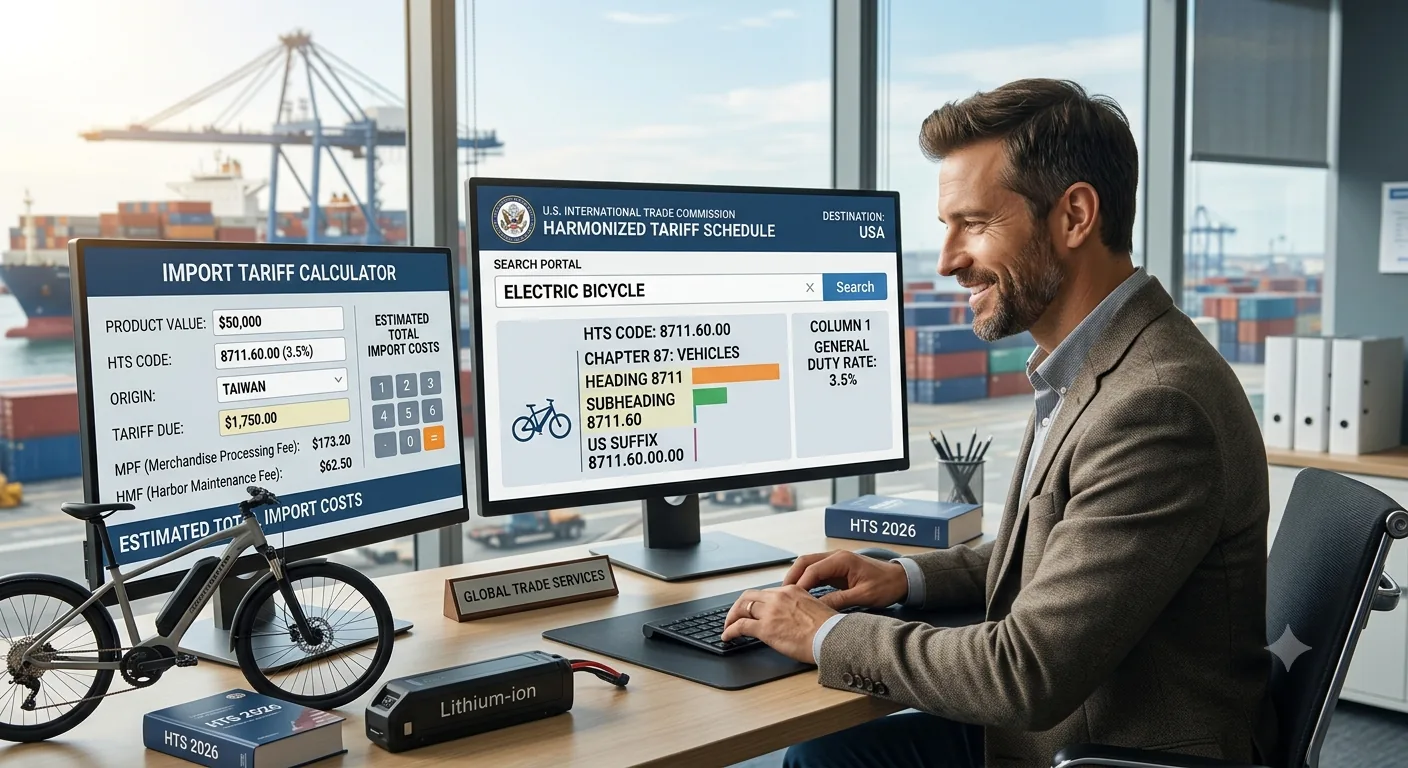
HTS (Harmonized Tariff Schedule) is the exclusive 10-digit tariff coding standard for US imports, the core basis for US import customs clearance and tariff calculation.
HTS Code Structure Breakdown
First 6 digits: Global universal HS code, consistent with international standards.
7-8 digits: US exclusive subdivided tariff items, the key part that determines your tax rate.
9-10 digits: US statistical codes, no impact on tariffs, only for official data statistics.
Core Warning
Never trust supplier-provided HS codes blindly in international shipping to the US! The first 6 digits are universal, but the US exclusive latter digits and matching tariff rates vary greatly. Misclassification is the top reason for US customs penalties.
02 3 Reliable Ways to Find the Correct US HTS Code
In freight shipping business, accurate classification always comes first. Here are three authoritative and practical query methods for sellers.
Method 1: Official USITC Website Query (Most Authoritative & Common)
USITC (United States International Trade Commission) official website:https://hts.usitc.gov/, the only official HTS inquiry platform for US import logistics.
Operation tips: Prepare precise product descriptions including material, function, processing technology and usage scenario. Search by core keywords or browse by chapter (Chapter 61/62 for apparel, Chapter 84/85 for electronics, Chapter 39 for plastic products).
Key step: Must read chapter notes and general notes! Many products seem matching but are excluded officially, which is the biggest pitfall for new sellers in global shipping.
Method 2: CBP CROSS Database Ruling Inquiry
Visit rulings.cbp.gov to check historical customs rulings of similar products. If CBP has fixed classification standards for your goods, this result has legal priority and is the most reliable reference for cross-border shipping classification disputes.
Method 3: Licensed Broker + Binding Ruling (For High-Value Goods)
Sellers are legally responsible for declaration accuracy, not suppliers or freight forwarder service providers. For high-value or complex goods, hire a licensed customs broker. For absolute safety, apply for CBP Binding Ruling, which is legally valid at all US ports.
03 Complete Formula to Calculate US Import Tariff & Landed Cost
US freight shipping cost calculation is not a single tariff, but a superposition of multiple taxes and fees. Master this set of formulas to accurately budget all import costs.
Step 1: Confirm Customs Value (Tax Basis)
The US customs adopts transaction value pricing, including product invoice amount, packaging cost, auxiliary costs (free molds/drawings provided to factories), and patent royalties. FOB terms exclude international freight and insurance; CIF/DDP terms include them.
Step 2: Confirm MFN Base Tariff
Check the “Column 1 – General” rate of the 8-digit HTS code, applicable to China and other WTO member countries. It can be ad valorem duty, specific duty or compound duty.
Step 3: Superimpose Additional Tariffs (Core Cost of US Shipping)
All additional tariffs are accumulated based on customs value, the main reason for soaring international shipping costs to the US:
- Section 301 Tariff: Applicable to China/Hong Kong originated goods, 7.5% or 25% based on different lists
- Section 232 Tariff: For steel, aluminum and auto products, 25%-50%
- IEEPA Reciprocal Tariff: Dynamic adjustment, 10%-20%+
- AD/CVD Anti-Dumping & Countervailing Duty: Product-specific, up to 100%+
Step 4: Calculate CBP Official Fees
MPF (Merchandise Processing Fee): 0.3464% of customs value (min $31.67 / max $614.35), applicable to formal declaration
HMF (Harbor Maintenance Fee): 0.125% of customs value, only for sea freight shipping (air/land shipping exempted)
Step 5: Final Full Cost Formula
Total Tariff = (Customs Value × [Base Rate + All Additional Rates]) + MPF + HMF + AD/CVD
Landed Cost = Product Cost + International Freight + Insurance + Total Tariff + Domestic Delivery Fee
04 Real Calculation Case (China to US Sea Freight)
Product: Plastic daily necessities | HTS: 3926.90.xxxx | Base tariff: 5.3% | Section 301 additional tariff: 25%
Customs Value: $50,000 | Shipping Method: Sea freight shipping
Base Tariff: $50,000 × 5.3% = $2,650
Section 301 Additional Tariff: $50,000 × 25% = $12,500
MPF Fee: $50,000 × 0.3464% = $173.20
HMF Fee: $50,000 × 0.125% = $62.50
Total Taxes & Fees: $15,385.70 | Comprehensive Tax Rate: 30.77%
Final Thought
Ininternational shipping and US cross-border business, HTS code accuracy and tariff calculation determine your final profit.
Many sellers only focus on freight shipping prices but ignore tariff superposition rules, resulting in zero profit or even loss after goods arrive. Standard HTS classification and accurate cost accounting are the basic skills for stable US global shipping business.
Always verify codes via official channels, reserve tariff space in advance, and avoid customs risks through standardized freight forwarding operation.
If you need HTS code confirmation, US tariff calculation or stable international freight shipping solutions, feel free to contact us: [email protected].