
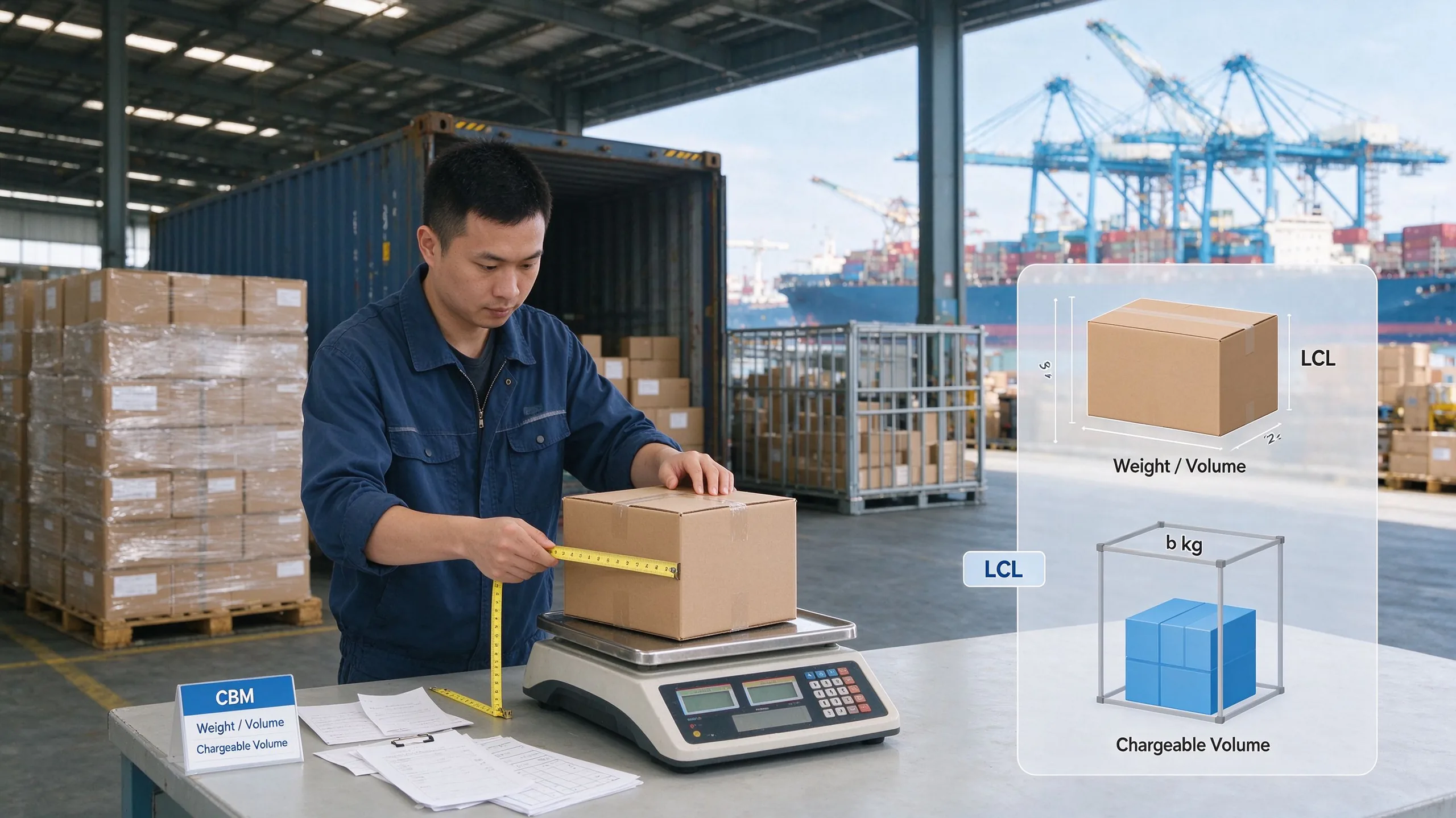
LCL, short for less than container load, bills shipments by chargeable volume. This guide shows you how to calculate CBM and total LCL shipping cost step by step.
What is LCL shipping?
LCL (less than container load) means multiple shippers share one ocean container. You only pay for the space your cargo occupies, instead of renting a full container. This option fits sellers with cargo below 12–15 CBM, such as Amazon FBA replenishment batches. If you want to learn our full freight solutions, check our China freight forwarding service overview. Many FBA sellers also combine LCL with our warehouse consolidation before shipment.
How do you calculate shipment CBM for LCL?
CBM stands for cubic meter, the standard volume unit for sea freight. The formula is length (m) × width (m) × height (m) × carton quantity. If you measure in centimeters, divide the total product by 1,000,000 to convert to CBM. For mixed carton sizes, calculate each group separately and add all results. Carriers use the outer carton dimensions, not product dimensions. Packing gaps, pallet height and overhang will increase the final measured volume.
What is chargeable volume and W/M rule for LCL?
LCL carriers apply the W/M (Weight or Measurement) rule. They compare your total CBM and total gross weight divided by 1000, then charge on the higher value. One metric ton equals 1 CBM under this standard. For heavy dense goods like metal parts, weight usually controls billing. For light bulky goods such as plastic home goods, volume becomes the chargeable basis. Most forwarders set a minimum charge of 0.5 CBM for any LCL shipment.
What costs make up your total LCL price?
LCL quotes often separate ocean freight and local handling fees. Use this table to list standard charges.
|
Fee Item |
Explanation |
Notes |
|
Ocean freight |
Base sea rate per CBM |
Route-dependent, volatile |
|
Origin CFS charge |
Consolidation fee at Chinese warehouse |
Per shipment |
|
Destination CFS charge |
Deconsolidation fee at destination port |
Paid by consignee usually |
|
Customs declaration & entry |
Documentation and customs filing |
Separate for import and export |
|
Delivery fee |
Last-mile delivery to warehouse or FBA |
Based on postcode |
Many sellers only compare the ocean rate and miss destination CFS fees, which cause budget overruns. If you ship to Amazon fulfilment centres, review our guide on shipping to Amazon FBA to confirm FBA receiving rules before booking.
Common calculation mistakes that raise your LCL cost
Using inner box size instead of outer carton size is the most frequent error. Some sellers ignore pallet dimensions or shrink-wrap overhang, and the CFS re-measurement will add extra volume. Another mistake is mixing different packaging batches without sorting. Forwarders may round up each carton group individually. You should also confirm the quotation’s Incoterm, such as FOB, CIF or DDP, to confirm which party pays local fees.
FAQ
1. What is the best volume threshold to switch from LCL to FCL? Most sellers switch to FCL, full container load, when cargo reaches 12–15 CBM. Above this range, per-CBM cost of LCL usually exceeds FCL.
2. Does palletisation change my CBM calculation? Yes. Pallet height and width are included. You must measure the full pallet, not just the goods stacked on it.
3. Can I get a fixed LCL rate for months? Ocean freight rates fluctuate weekly. No fixed long-term rate is guaranteed. Lock rates only after confirming cargo dimensions and ready date.
4. What is the minimum LCL shipment size? Most providers apply a 0.5 CBM minimum charge, even if your actual cargo is smaller.
5. Do Amazon FBA LCL shipments need extra documentation? Yes. You need commercial invoice, packing list, FNSKU labels and import filing documents, depending on your destination country.
Closing
Accurate CBM and chargeable volume calculation is the foundation of reliable LCL quotations. Measure outer cartons, confirm W/M billing rules and list all local fees before comparing offers. If you prepare multi-supplier cargo for FBA replenishment, consolidation and pre-inspection before LCL handover can reduce re-measurement delays and receiving failures.