Login
Mastering Customs Clearance: Key Documents and Common Pitfalls
December 23, 2025
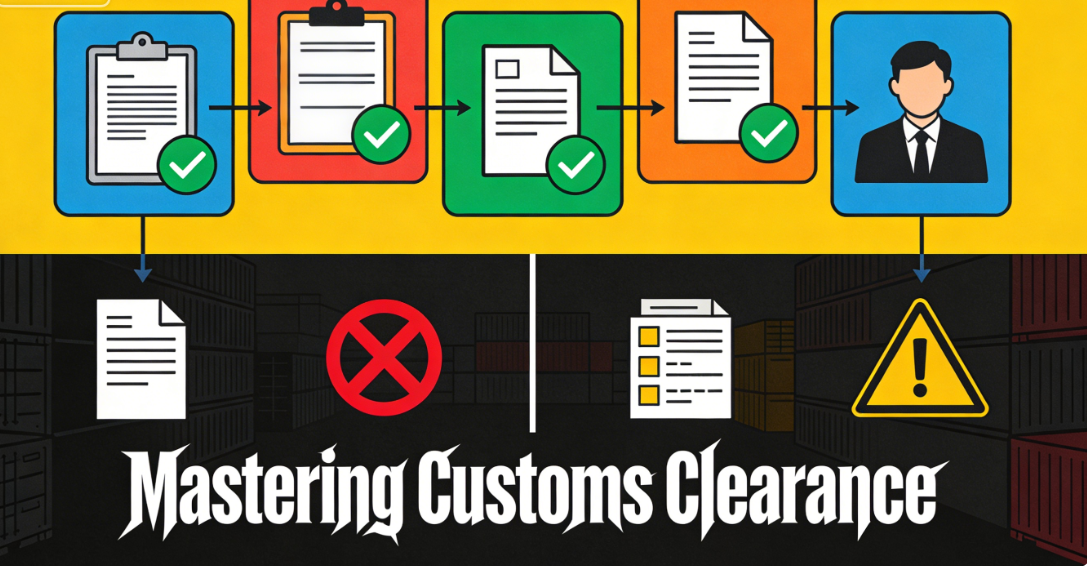
Navigating the complexities of international shipping is a critical step for any business moving goods from China to global markets. For cross-border e-commerce sellers on Amazon, Walmart, or Shopify, as well as for manufacturing companies and retailers, a smooth customs clearance process is the linchpin of a successful supply chain. Delays, unexpected fees, or seized shipments can derail your operations and impact customer satisfaction.This guide will walk you through the essential documents required for shipping from China and highlight common pitfalls to avoid, ensuring your goods move seamlessly across borders to your international customers.
The Critical Role of Customs Clearance
Customs clearance is the official process where government authorities review your shipment’s documentation and, if necessary, inspect the goods to ensure compliance with all import/export laws, regulations, and tariffs. Success here means faster delivery times, predictable costs, and happy customers. Failure can be costly.
Key Documents for a Smooth Customs Clearance Process
Having the correct paperwork in order is non-negotiable. Here are the key documents you need when importing from China:
- Commercial Invoice: This is the most important document. It must accurately detail the seller, buyer, description of goods, quantity, value of goods (per unit and total), currency (e.g., USD, EUR), and Incoterms (e.g., FOB Shanghai, CIF Los Angeles). Customs uses this to assess duties and taxes. Inaccuracies are a leading cause of customs delays.
- Packing List: This document complements the commercial invoice. It provides a detailed, item-by-item breakdown of what is in each package, including weight, dimensions, and package type. It helps customs officials verify the shipment’s contents quickly.
- Bill of Lading (Ocean) or Air Waybill (Air): This is the contract between the shipper and the carrier. For ocean freight, a Bill of Lading acts as both a receipt and a title document. For air freight, the Air Waybill serves as a receipt. Ensure all details match your commercial invoice and packing list exactly.
- Certificate of Origin (COO): This document certifies the country where the goods were manufactured. It is crucial for determining applicable tariffs, especially under free trade agreements. Your supplier in China or a local chamber of commerce can often help issue this.
- Import License/Permits (if required): Certain restricted goods (e.g., electronics, food, pharmaceuticals, textiles) may require specific permits from the destination country. Always research your product’s HS code (Harmonized System code) to identify any special requirements.
Common Pitfalls in Customs Clearance and How to Avoid Them
Even experienced shippers can stumble. Here are the most frequent mistakes and how to steer clear of them:
Pitfall 1: Incomplete or Inaccurate Documentation
The Risk: The 1 cause of shipping delays and customs holds. A simple typo in the address, product description, or HS code can trigger an inspection.
The Solution: Double and triple-check all documents for consistency. Ensure product descriptions are clear and specific (avoid generic terms like “gadget” or “parts”). Use professional freight forwarder services if you’re unsure, as they have expertise in documentation.
Pitfall 2: Misclassifying the HS Code
The Risk: The HS code dictates the duty rate and regulatory requirements. An incorrect code can lead to underpayment (fines and penalties) or overpayment (lost profit).
The Solution: Invest time in correctly classifying your products. Consult with your Chinese supplier, a customs broker, or use official government databases. Don’t guess.
Pitfall 3: Undervaluing Goods on the Commercial Invoice
The Risk: Intentionally undervaluing goods to save on duties is illegal. It can result in severe penalties, shipment seizure, and damage to your business’s credibility.
The Solution: Always declare the accurate value of goods. The short-term savings are never worth the long-term risk.
Pitfall 4: Not Understanding Incoterms & Total Landed Cost
The Risk: Unclear Incoterms (like EXW, FOB, DDP) can lead to confusion over who is responsible for shipping costs, insurance, and duties. This creates unexpected bills and logistics problems.
The Solution: Clearly agree on Incoterms with your China supplier. Calculate your total landed cost—including product cost, international shipping, insurance, duties, and local taxes—to understand your true profit margin.
Pitfall 5: Neglecting Product Compliance and Restrictions
The Risk: Shipping goods that don’t meet the destination country’s safety, labeling, or environmental standards (e.g., CE mark for Europe, FCC for USA) can lead to rejected shipments.
The Solution: Before production, research all product compliance and customs regulations for your target market. Ensure your manufacturer is aware of and can meet these standards.
Partnering for Success: Your China Fulfillment Solution
Mastering customs clearance is a vital skill for global e-commerce success. While understanding the process is key, you don’t have to manage it alone. Partnering with an experienced China fulfillment center or third-party logistics (3PL) provider in China can transform this complex challenge into a streamlined part of your operation.
A reliable partner like EasyChinaWarehouse can handle everything from warehousing and order fulfillment to ensuring all export documentation from China is flawless. We act as your local expert, navigating customs regulations, optimizing shipping costs, and ensuring your supply chain from China to USA, Europe, or elsewhere is efficient and reliable.Ready to simplify your international shipping from China? Contact us today to learn how our end-to-end logistics solutions can help you avoid customs clearance pitfalls and get your products to market faster.