Login

Middle East Conflict Ignites Global Supply Chain Crisis: How Cross-Border Sellers Can Weather the “Logistics Storm”
March 27, 2026
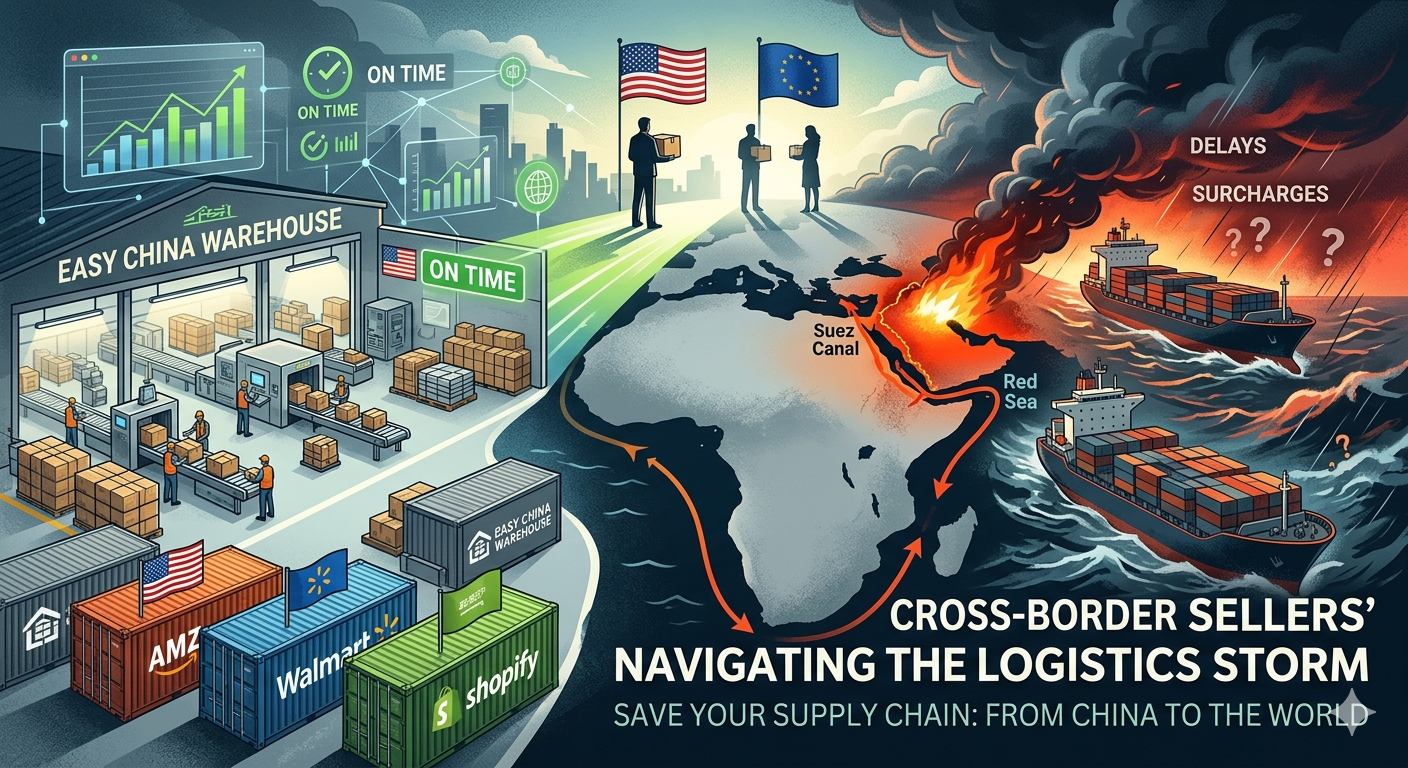
The global supply chain is no stranger to volatility, but the escalating conflict in the Middle East has sent shockwaves through the industry that haven’t been seen since the 2021 Suez Canal blockage. For cross-border e-commerce sellers on platforms like Amazon, Walmart, and Shopify, as well as international retailers and manufacturing companies, the “logistics storm” is no longer a distant threat—it is a daily operational challenge.
With Red Sea shipping routes disrupted and the Cape of Good Hope becoming the “new normal” for transit, how can businesses shipping from China protect their bottom line?
In this guide, we explore the impact of the Middle East conflict on global trade and provide actionable strategies for saving your cross-border business from rising costs and shipping delays.
The Ripple Effect: Why the Middle East Conflict Matters to You
The Red Sea is the gateway to the Suez Canal, handling roughly 12% of global trade and 30% of the world’s container traffic. As vessels reroute around Africa to avoid regional instability, the impact on China-to-West logistics is profound:
1,Extended Lead Times: Rerouting around the Cape of Good Hope adds 10 to 14 days to transit times. For Amazon sellers, this increases the risk of “Out of Stock” (OOS) status, which kills organic search rankings.
2,Skyrocketing Freight Rates: Fuel consumption is up, and container availability is down. We are seeing a surge in ocean freight surcharges and “Peak Season” pricing in what should be the off-season.
3,Container Imbalances: As ships take longer to return to Chinese ports, a shortage of empty equipment in manufacturing hubs like Shenzhen, Ningbo, and Shanghai is driving up local export costs.
5 Strategies for Cross-Border Sellers to Surmount the “Logistics Storm”
To survive this era of uncertainty, sellers must move away from “Just-in-Time” inventory and embrace “Just-in-Case” resilience. Here is how you can save your business:
1. Diversify Your Shipping Routes and Modes
Don’t put all your eggs in the ocean freight basket. While sea freight is the most economical, the current delays make it risky for high-demand SKUs.
Air Freight: Use this for lightweight, high-margin products or to “bridge the gap” while waiting for sea shipments.
Sea-Air Solutions: Consider hybrid routes that move goods by sea to a stable hub (like Dubai or Singapore) and then by air to the final destination.
China-Europe Railway Express: For sellers targeting the EU market, rail remains a viable, faster alternative to the circumnavigation of Africa.
2. Leverage China-Based Warehousing for Agility
During a logistics crisis, the closer your inventory is to the source of manufacturing, the better. By utilizing an integrated China warehouse, you can:
Consolidate Shipments: Combine orders from multiple suppliers into one container to save on freight costs.
Quality Control at the Source: Ensure your goods are perfect before they undergo a 40-day journey. This prevents the nightmare scenario of paying high shipping fees for defective products.
On-Demand Dispatch: Instead of shipping everything to a costly US or UK 3PL at once, keep “buffer stock” in China and ship in smaller, more frequent batches based on real-time platform data.
3. Optimize for Dimensional Weight (Dim Weight)
With freight rates climbing, you are paying for every cubic centimeter of space. Now is the time to audit your packaging. Reducing box sizes by even 10% can lead to thousands of dollars in savings when shipping at scale. Work with your fulfillment partner in China to provide professional repacking and kitting services.
4. Adjust Inventory Forecasting and Pricing
The “Logistics Storm” requires a mindset shift. If your lead time has increased by 15 days, your reorder point must move up accordingly.
Buffer your stock: Aim for 30 days of additional safety stock to handle transit volatility.
Dynamic Pricing: If your shipping costs have risen by 20%, consider incremental price adjustments on Shopify or Amazon to maintain your margins without losing your “Buy Box” eligibility.
5. Partner with a Transparent Logistics Provider
In a crisis, information is power. You need a logistics partner that provides real-time tracking, transparent surcharge breakdowns, and proactive communication. Avoid “black box” forwarders; instead, look for partners who understand the nuances of DDP (Delivered Duty Paid) and FBA prep during turbulent times.
How Easy China Warehouse Can Help
At Easy China Warehouse, we specialize in helping international retailers and e-commerce sellers streamline their supply chains from the heart of China’s manufacturing hubs. Whether you are battling high ocean rates or looking for a more efficient way to manage your Shopify fulfillment, our team is equipped to help you navigate the Middle East logistics crisis.
Our Services Include:
Secure warehousing and inventory management in China.
Professional FBA labeling, kitting, and inspection.
Flexible shipping options (Sea, Air, Rail, and Express).
Cost-saving consolidation for multi-supplier sourcing.
Conclusion: Don’t Wait for the Calm
The Middle East conflict has reminded us that the global supply chain is fragile. However, for the proactive seller, this “logistics storm” is also an opportunity to outmaneuver competitors who are slow to adapt. By diversifying your routes, optimizing your packaging, and leveraging China-based fulfillment, you can ensure your products reach the international market—on time and on budget.
Ready to optimize your supply chain? Contact Easy China Warehouse today to get a custom shipping quote and see how we can help you save your cross-border business.