
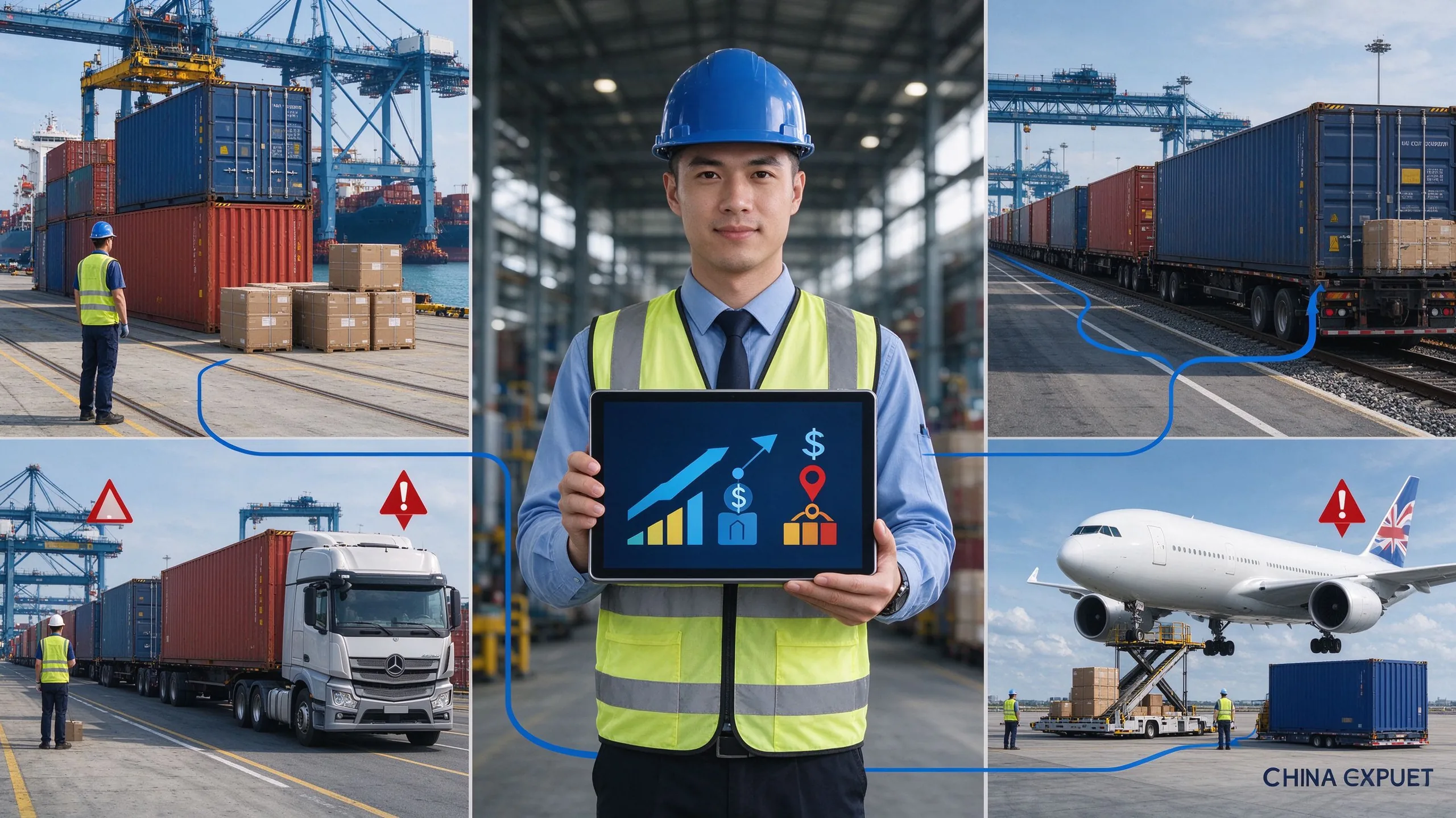
Four primary shipping options connect China to Europe and the UK. Your selection depends on shipment volume, lead time requirement, and product value. Air freight delivers fast at high cost; sea freight offers low unit cost with longer transit.
What is sea freight and when should you use it?
Sea freight moves cargo by ocean vessel. It includes full container load (FCL), a shipment occupying one complete container, and less than container load (LCL), consolidated cargo sharing space with other shipments. It is the lowest-cost option for large, non-urgent inventory.
Door-to-door transit for sea freight from China to Europe and UK averages 30–40 days, based on 2026 industry data from freight carrier public schedules. FCL works best for volumes above 15 CBM. LCL suits shipments of 1–15 CBM. Per-unit cost drops significantly with larger volume. This method handles oversized and heavy goods that air freight cannot accept. The main weakness is slow transit and possible delays from port congestion or canal disruptions. Amazon FBA sellers commonly select sea freight for bulk restocking of stable-selling products.
What is railway freight and when should you use it?
Railway freight uses China-Europe block trains to move containers over land. It sits between sea and air on cost and speed. It is ideal for medium-volume cargo that needs faster transit than sea freight but cannot support air freight rates.
Typical door-to-door transit time ranges from 18–25 days to Europe and UK, as published by rail operators in July 2026. Railway freight avoids ocean route risks such as port backlogs. It accepts FCL and LCL shipments. Sellers often use this channel for mid-value seasonal stock. Its cost is higher than sea freight but much lower than air freight. Restrictions apply for dangerous goods, same as ocean transport.
What is truck shipping and when should you use it?
Truck shipping, also called road freight, uses overland trucks for China to Europe and UK deliveries. Goods travel by truck across border checkpoints after domestic pickup. It offers flexible pickup and delivery windows for medium consignments.
Transit time for truck shipping averages 22–28 days door to door. It has fewer consolidation constraints than rail LCL and supports flexible loading sizes. Truck freight works well for palletised goods, small batch restocks and shipments that require direct delivery to warehouses. Border inspection delays may occur at frontier crossing points. It is less common for very large container volumes compared with sea or rail.
What is air freight and when should you use it?
Air freight transports cargo via commercial aircraft. It is the fastest of these four transport modes. It fits high-value, time-sensitive goods or emergency inventory replenishment.
Standard air freight door-to-door transit takes 5–10 days, including customs clearance. Air freight pricing is calculated by actual weight or dimensional weight, whichever value is larger. It is suitable for shipments from 45 kg up to 500 kg. Electronics, fast fashion and stock for urgent Amazon FBA restocks are typical use cases. Its per-unit cost is far higher than sea, rail or truck shipping. Air freight also enforces strict limits on item dimensions, weight and commodity types.
How do these four shipping modes compare side by side?
|
Shipping Mode |
Door-to-door Transit |
Best Volume |
Primary Strength |
Key Limitation |
|
Sea Freight |
30–40 days |
1 CBM+ LCL / 15 CBM+ FCL |
Lowest unit cost |
Long lead time, ocean disruption risk |
|
Railway Freight |
18–25 days |
1 CBM+ |
Balanced speed and cost |
Less capacity than sea |
|
Truck Shipping |
22–28 days |
Pallet / small bulk |
Flexible loading & delivery |
Border delay risk |
|
Air Freight |
5–10 days |
45 kg–500 kg |
Fastest transit |
High cost, strict size limits |
What core factors decide your shipping selection?
You should evaluate four metrics before locking a shipping method.
1. Required lead time: Calculate your sales velocity and warehouse stock buffer to set acceptable transit days.
2. Shipment volume and weight: Large volumes favour sea freight; small urgent batches use air freight.
3. Product value and risk: High-value goods reduce holding cost losses with faster transport.
4. Destination rules: Confirm VAT, IOR and customs filing requirements for EU or UK before booking.
Frequently Asked Questions
Q1: Which shipping method is cheapest from China to Europe and UK?
A1: Sea freight is the cheapest for large shipments. For cargo under 15 CBM, compare LCL sea, rail and truck quotes before deciding.
Q2: Can railway freight deliver directly to Amazon FBA warehouses in UK and EU?
A2: Yes. Most freight forwarders offer door-to-door rail service to Amazon FBA sites. You still need correct commodity classification and customs documentation.
Q3: Is truck shipping reliable for regular ecommerce restocks?
A3: It can be reliable for palletised shipments. Schedule buffer time for border customs checks, especially during peak seasons.
Q4: What dimensional weight rules apply for air freight?
A4: Air carriers charge by the greater value between actual weight and dimensional weight. Always measure packed dimensions before requesting air freight quotes.
Q5: When should sellers combine multiple shipping modes?
A5: Sellers can split inventory. Use sea freight for base stock, and air freight for small emergency top-ups to avoid stockout.
Conclusion
Sea freight, railway freight, truck shipping and air freight each serve distinct business needs for shipments from China to Europe and UK. Sea freight works for large low-urgency inventory. Railway freight balances cost and speed. Truck shipping suits flexible pallet deliveries. Air freight handles urgent, high-value goods. Match your choice to your stock turnover, budget and compliance requirements.
Easy China Warehouse (ECW) provides freight consolidation, cargo measurement and document preparation support for shipments bound for Europe and the UK. Our team helps importers and ecommerce sellers compare landed cost for all four transport options.
Contact Us