
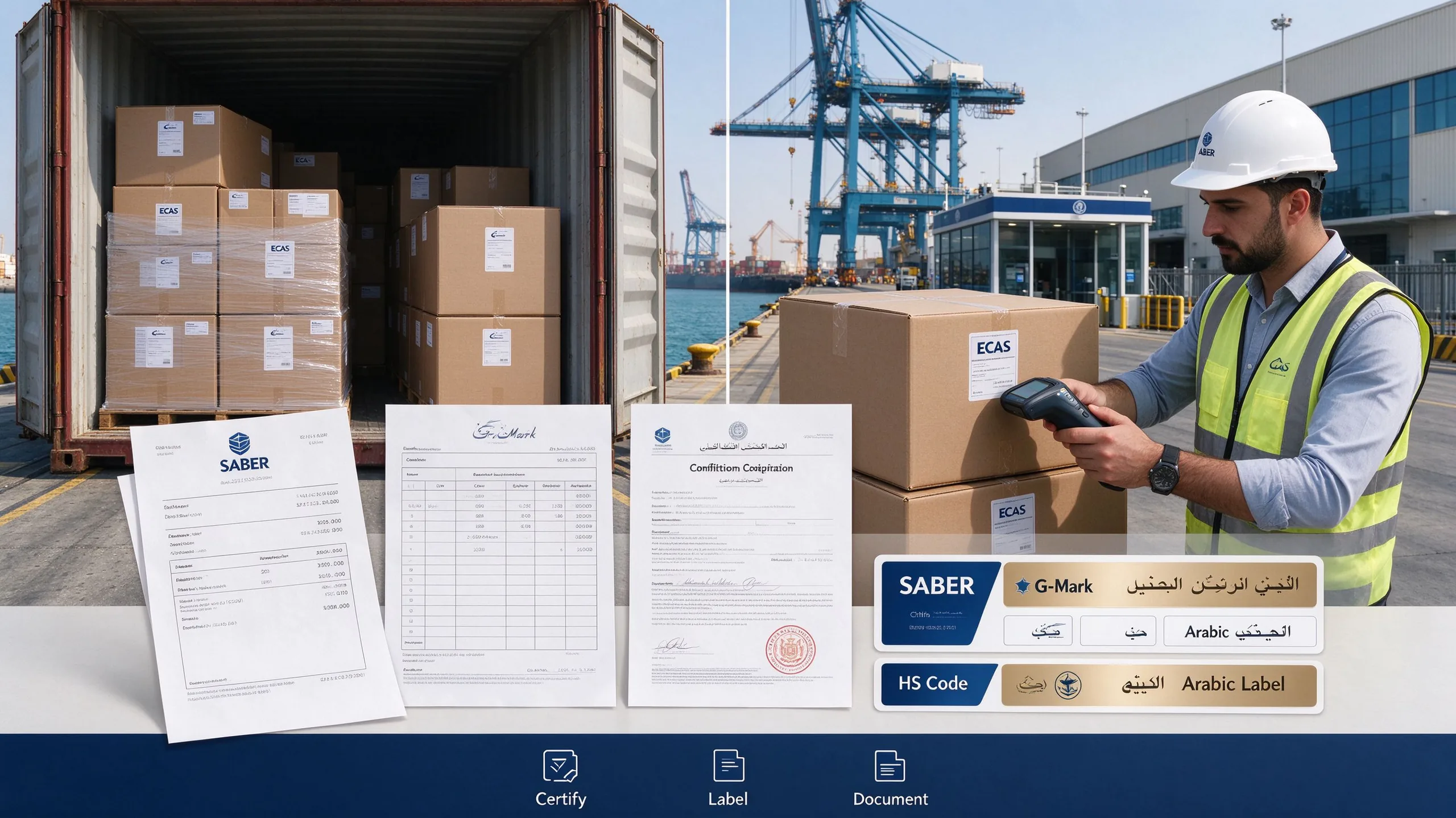
Shipments to the Middle East require country-specific certifications, Arabic labelling and accurate HS codes to avoid customs holds.
What core certification systems do you need for GCC shipments in 2026?
Saudi Arabia uses the SABER platform, run by the Saudi Standards, Metrology and Quality Organization (SASO). You need a Product Certificate of Conformity (PCoC) and Shipment Certificate of Conformity (SCoC) before cargo arrives. The United Arab Emirates follows the ECAS scheme for regulated goods. Other GCC members including Qatar, Oman and Kuwait enforce G-Mark for many electrical products. Certificates cannot be applied after arrival; late applications lead to cargo rejection, according to SASO notice published July 2026. If you need reliable end-to-end logistics support for your GCC shipments, review our China freight forwarding service.
What labelling rules apply to Middle East imports?
Most Gulf states require permanent Arabic and English dual-language labels on outer packaging. For Saudi shipments starting October 1, 2026, regulated goods must print the local supplier name and Commercial Registration (CR) number clearly. Product name, origin, batch number and expiry date must match the commercial invoice. Handwritten labels or stickers that peel off will fail inspection. Food, cosmetics and chemical products carry stricter GHS hazard marking rules. You can arrange pre-shipment label inspection and relabeling through our e-commerce warehouse service.
What documents are mandatory for customs clearance?
The standard document set covers commercial invoice, packing list, bill of lading or air waybill, certificate of origin and relevant conformity certificates. The invoice must state correct HS code, unit price, total CIF value and full product description. Vague descriptions such as “gift” or “parts” trigger customs audit. Some categories like food, medical devices and telecommunication goods need extra import permits.
What are the main prohibited and restricted goods across the Middle East?
Alcohol, pork-related products, religious sensitive materials and Israeli-origin goods are banned in Saudi Arabia and many GCC ports. Electronic products, toys, cosmetics and home appliances sit under restricted categories and need valid conformity certificates. Even samples and promotional gifts follow the same import rules. Sellers should confirm the banned list before booking cargo space.
How do you pick the right shipping term for Middle East routes?
DAP (Delivered At Place) is safer for most new sellers, because the local importer controls customs clearance and tax filing. DDP (Delivered Duty Paid) carries higher risk if your forwarder cannot work with a valid local importer. Many shared local importer schemes get rejected by Saudi ZATCA and UAE customs in 2026. Confirm tax liability and clearance responsibility before signing a booking.
|
Country |
Main certification |
Key label requirement |
|
Saudi Arabia |
SABER (PCoC + SCoC) |
Arabic + English, local CR number |
|
UAE |
ECAS |
Arabic dual label for regulated goods |
|
Qatar / Oman / Kuwait |
G-Mark for electrics |
Arabic product description |
FAQ
1. Can I apply SABER certificates after cargo arrives at the port? No. SASO rules state SCoC must be issued before shipment departs China. On-site applications are not accepted in 2026.
2. Do small sample parcels also need SABER? Yes. Samples are not exempt from the SABER system for regulated product categories.
3. Is Arabic labelling required for inner retail boxes or only outer cartons? Both retail packaging and outer shipping cartons need compliant Arabic marking for regulated goods.
4. Does one SCoC certificate cover multiple shipments? No. One SCoC ties to one single shipment. PCoC is valid for one year for the same product.
5. Can I use a shared local importer for Saudi clearance? Shared importer records are increasingly audited by ZATCA. Using a dedicated local importer lowers detention risk.
Ending
Middle East compliance rules are updated frequently in 2026. Certification, label and document checks before shipment reduce detention and return costs. Work with your logistics provider to complete all compliance checks before cargo leaves China.