
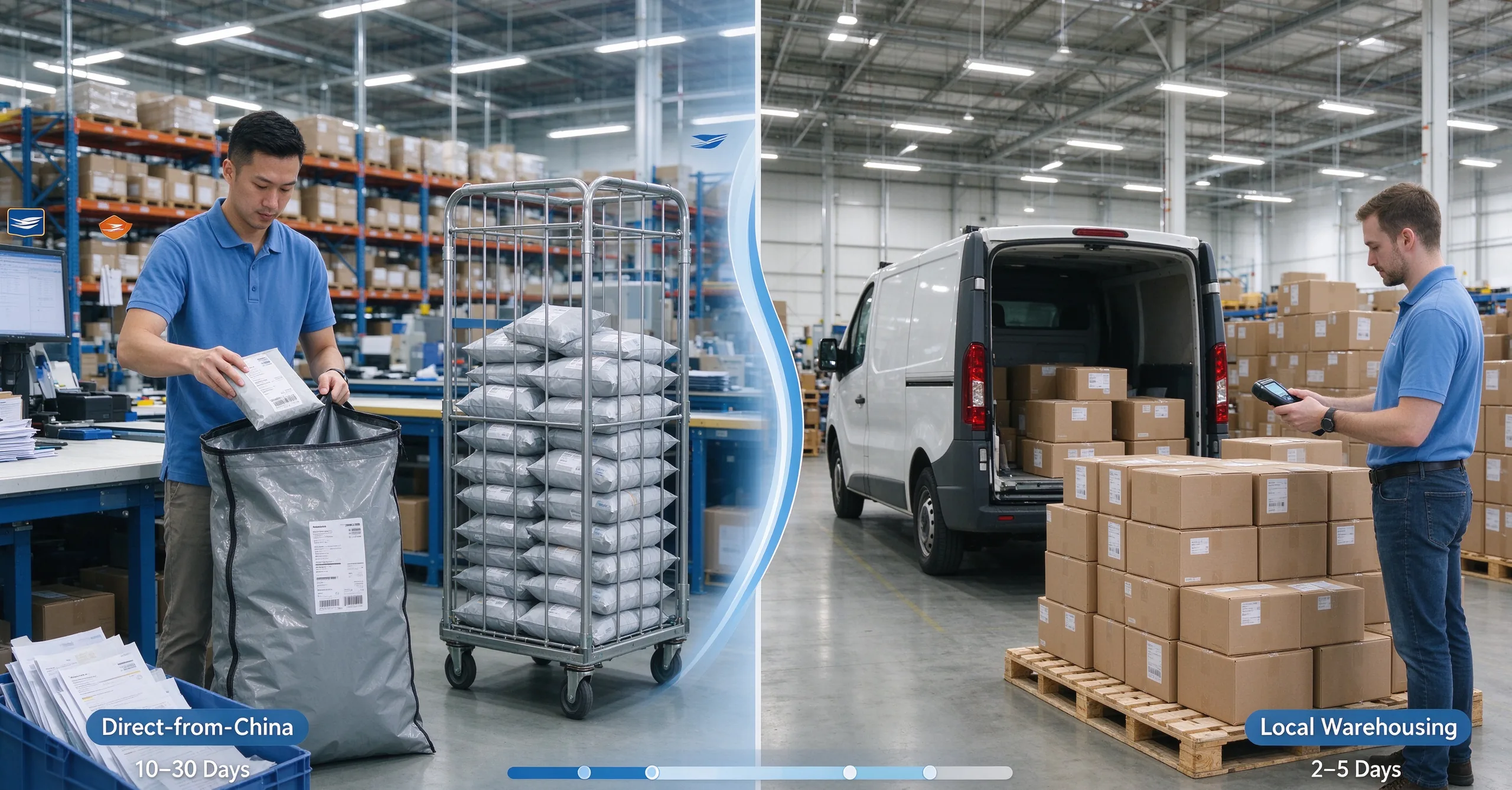
You choose direct-from-China shipping for low upfront cost and SKU testing. Local warehousing speeds up delivery and lifts conversion, but requires bulk inventory investment.
What is direct-from-China shipping for Shopify stores?
Direct-from-China shipping means you hold inventory in China and ship individual parcels straight to overseas buyers after each order comes in. No bulk pre-shipment to foreign territories is needed. This fulfillment model has very low capital pressure.
This method works well for new Shopify sellers with small daily order volumes. You can launch dozens of new SKUs without stocking large quantities. Per-order shipping cost averages $3–8 for small parcels, according to Shopify merchant data published in August 2026Shopify. The main downside is long lead time: 10–30 days door to most EU and US destinations. Slow delivery raises refund requests and negative reviews. Return processing also becomes difficult, because buyers cannot send goods back to China at low cost. Most merchants choose full refunds instead of arranging return shipments.
What is local warehousing for Shopify order fulfillment?
Local warehousing means you send bulk cargo via sea or air freight to an overseas 3PL warehouse in advance. When orders arrive on Shopify, the local team picks, packs and ships out via domestic carriers. This is local fulfillment with no cross-border transit for individual parcels.
Delivery shortens sharply to 2–5 days for US and EU buyers. Faster shipping improves store conversion rates and reduces customer complaints. You can set up a local return address to handle after-sales issues easily. Bulk headlong freight cuts per-unit shipping cost significantly for steady-selling products. The core drawback is high capital outlay. You must pay for bulk inventory, monthly storage fees and inbound freight. Unsold goods turn into dead stock if sales drop suddenly. Many growing sellers only move top-selling SKUs to local warehouses and keep long-tail items in China.
Side-by-side comparison table
|
Comparison Item |
Direct-From-China Shipping |
Local Warehousing |
|
Door-to-door lead time |
10–30 days |
2–5 days |
|
Upfront capital requirement |
Low, no bulk inventory |
High, bulk stock + storage fees |
|
Per-order shipping cost |
Higher for single parcels |
Lower for bulk pre-shipped inventory |
|
Return handling |
Hard, costly cross-border returns |
Easy, local return address available |
|
SKU flexibility |
High, test new products freely |
Low, only for proven steady sellers |
|
Customer conversion |
Lower due to long transit |
Higher with fast domestic delivery |
Which model fits your Shopify business stage?
Select your fulfillment plan based on store maturity, order volume and cash flow. New stores with less than 5 daily orders should stick to direct-from-China shipping. This setup limits financial risk while you test new products and find winning listings. You avoid locking capital into unsold inventory. Once you have 10+ daily stable orders and confirmed top SKUs, shift fast-moving items to local warehousing. This step cuts shipping cost and improves buyer experience. Most scaling brands run a hybrid model: bestsellers stay in overseas local warehouses, while test items remain in China warehouses to control risk.
What hidden costs should Shopify sellers watch out for?
Direct-from-China shipping has two major hidden expenses: customs duty on individual parcels and high refund rates caused by long delivery times. Many buyers open disputes when tracking stays unchanged for weeks. Local warehousing carries storage fees, handling fees and dead stock losses. If you overstock seasonal goods, leftover inventory will generate continuous monthly storage charges. Always calculate landed cost including inbound freight, warehousing expense and potential inventory write-offs before bulk shipping goods overseas.
Frequently Asked Questions
Q1: Can I run both fulfillment models at the same time on Shopify?
A1: Yes. You can set separate fulfillment locations inside Shopify admin. Assign fast-selling goods to local warehouses and new test SKUs to China direct shipping. The system will automatically route orders to the correct warehouse.
Q2: Does local warehousing always reduce overall shipping cost?
A2: Only for steady high-volume SKUs. If order volume is low, storage and inbound freight will push total cost higher than direct parcel shipping from China.
Q3: Why do direct China shipments get more customer disputes?
A3: Long transit leads to slow tracking updates. Buyers mistake delayed parcels for lost packages. Dispute rates drop sharply once you switch to local domestic delivery.
Q4: How to handle returns when using direct-from-China shipping?
A4: Most merchants issue full refunds and let buyers keep the goods. You can also set up a local return consolidation point to collect returned items and ship them back to China in bulk to cut cost.
Q5: What is the best hybrid fulfillment strategy for growing Shopify stores?
A5: Keep top 20% bestsellers in local overseas warehouses. Keep the remaining long-tail and new test products in China. This balances low risk and fast delivery.
Conclusion
Direct-from-China shipping and local warehousing each serve distinct Shopify business phases. Direct China shipping delivers low risk and high flexibility for product testing and new stores. Local warehousing speeds up delivery, boosts conversion and simplifies after-sales support for mature listings with stable orders. Most profitable independent store operators use a mixed model to balance cash flow risk and customer experience.
Easy China Warehouse (ECW) provides China-based parcel consolidation and bulk inbound freight to overseas local warehouses for Shopify merchants. We help sellers build hybrid fulfillment plans and calculate full landed cost for both shipping modes.