
Foreword
If your business relies on sourcing products from multiple Chinese manufacturers for international shipping, there’s one logistics hack that instantly boosts profits while cutting risks: a China consolidation warehouse.
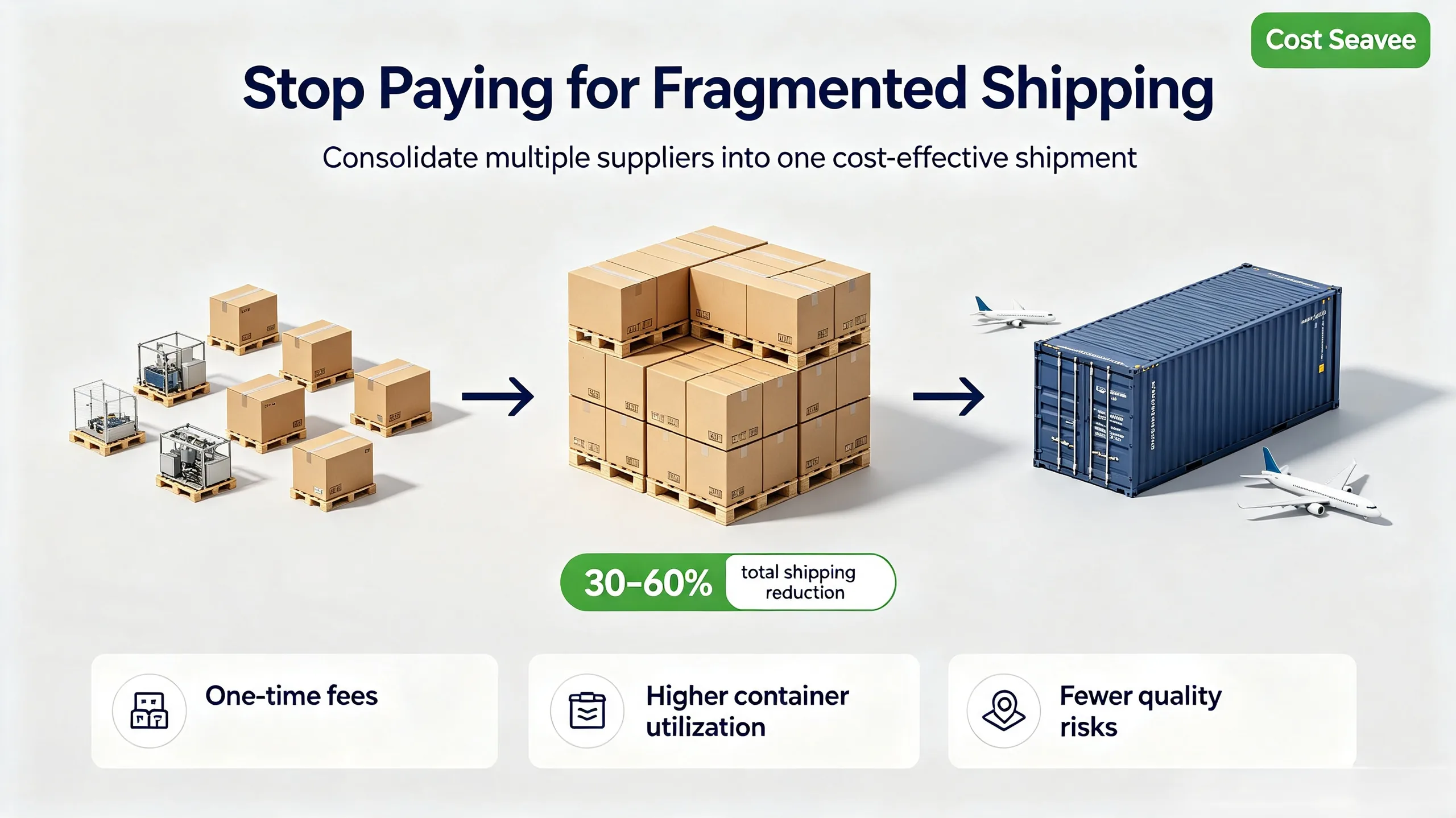
A lot of importers and cross-border sellers treat consolidation warehousing as an “extra service”. In reality, it’s a must-have core supply chain tool for multi-supplier sourcing. Sending separate freight shipping from individual factories seems convenient, but it secretly burns cash, creates quality risks, messes up order delivery, and drains your team’s energy.
In this full guide, we break down why every sourcing enterprise needs a China consolidation warehouse, covering cost savings, quality control, supply chain efficiency, compliance advantages, and manpower optimization, with real and practical logic.
01 Massive Cost Reduction: Cut 30%–60% of Overall Shipping Costs
The biggest pain point of scattered factory shipping is repeated redundant fees. Every single separate shipment triggers a full set of fixed logistics charges, which you can completely eliminate with consolidation.
1. Eliminate repeated port, customs and document fees
Each independent export shipment charges THC, warehouse entry fee, bill of lading fee, manifest fee, customs declaration fee and document fee. If you source from 10 factories, you pay these fees 10 times. With a consolidation warehouse, you only pay one single set of fees, cutting over 50% of basic logistics overhead instantly.
2. Avoid minimum weight/volume surcharges for small batches
Both sea and air freight shipping have minimum billing standards. Small orders from single factories are always overcharged because you pay for unused weight and space. Consolidating scattered small cargo into one large shipment removes these unreasonable minimum surcharges and greatly lowers unit shipping costs.
3. Huge price gap between LCL and FCL shipping
LCL (Less than Container Load) freight rates are normally 1.5 to 3 times higher than FCL (Full Container Load). Most multi-factory shipments end up as costly LCL cargo. A China consolidation warehouse combines all scattered goods into full containers, upgrading your shipping mode from expensive LCL to cost-effective FCL.
4. Optimize container space, stop paying for “air freight”
Factory packages are irregular and disorderly, leading to only 60%–70% container space utilization. Professional warehouse palletizing, compression packaging and standardized arrangement lift the space rate above 90%. This means you cut nearly 20% of volumetric freight waste in every international shipping cycle.
5. Remove duplicated destination port fees
Multiple inbound shipments mean multiple destination unloading fees, customs clearance fees, storage fees and agent handling fees. One consolidated shipment only incurs one-time destination charges, eliminating massive hidden overseas logistics costs.
02 Zero Overseas Quality Risks: Block Defects Before Export
The scariest part of separate factory shipping is discovering defective goods, missing items or wrong SKUs after ocean transit. Cross-border returns, rework and customer claims cause irreversible losses. A consolidation warehouse solves all these problems with pre-shipment control.
1. Unified inspection & quality screening
The warehouse checks quantity, appearance, product function and label compliance for all incoming goods. Unqualified products are rejected and sent back to factories for rework domestically, avoiding costly overseas quality disputes.
2. Standard packaging cuts damage rate sharply
Original factory packaging is usually thin and unprotected, easily causing dampness, extrusion and damage during long-haul freight shipping. The warehouse provides film wrapping, waterproof packing, reinforcement and standard palletizing, reducing cargo damage rate from 10%–20% to under 1%.
3. Avoid missing, wrong and mixed orders
Shipping from dozens of factories inevitably causes missing goods, mixed SKUs and mismatched orders. The consolidation team sorts, matches and double-checks all cargo based on order requirements, ensuring complete and accurate shipments.
4. Pre-labeling & compliance check to prevent customs detention
FBA labels, brand marks and compliance labels can be uniformly pasted in advance. The warehouse verifies complete certification documents, effectively avoiding customs detention, fines or destruction due to non-standard labeling in overseas international shipping clearance.
03 Higher Supply Chain Efficiency: Synchronized & Stable Order Fulfillment
Many sourcing businesses struggle not with stock shortages, but unsynchronized delivery. Inconsistent factory lead times lead to incomplete orders that cannot be sold or listed. Consolidation warehousing perfectly fixes this pain point.
1. Full cargo synchronization for complete order delivery
Different factories have different production speeds. With 7–14 days of free temporary storage, the warehouse waits for all accessories and finished goods to arrive before unified shipment. No more incomplete orders or split deliveries affecting sales.
2. Drastically reduce shipment tracking workload
10 suppliers mean 10 separate shipments, 10 tracking numbers and endless communication work. After consolidation, you only manage one single shipment, slashing daily logistics tracking and reconciliation pressure.
3. Flexible shipment plan adjustment
Based on overseas sales performance, you can add, reduce, merge or split orders flexibly in the consolidation warehouse. It is far more adjustable than fixed factory direct shipping.
4. Shorten and stabilize overall lead time
Unified booking and container loading avoid overall delay caused by individual shipment hold-ups. FCL consolidated shipments enjoy higher boarding priority, making your entire global shipping cycle more stable and predictable.
04 Optimized Compliance for Sensitive Goods: Safer & Cheaper
For batteries, magnets, cosmetics, liquids and powders — common sensitive goods in cross-border trade — consolidation warehousing brings overwhelming advantages in compliance and cost control.
1. One-time DG declaration to avoid repeated dangerous goods fees
Separate shipments of battery products incur independent DG surcharges, dangerous packaging fees and inspection fees every time. Consolidated one-time declaration cuts sensitive goods logistics costs by over 40%.
2. Professional compliance operation lowers detention risks
Professional consolidation warehouses are familiar with China export rules and overseas clearance standards. Unified document sorting and standardized packaging greatly reduce customs inspection, detention and return risks.
3. Mixed loading of general and sensitive goods
Reasonable mixed loading of ordinary products and sensitive goods optimizes container space and shipping structure, achieving higher efficiency and lower cost than separate freight shipping arrangements.
05 Lower Management & Labor Costs, Simplify Team Operation
A China consolidation warehouse centralizes all logistics work, greatly reducing your internal operational burden.
1. Less supplier communication cost
Your team no longer needs to negotiate packaging, delivery time and logistics with every factory. All docking work is handled by the warehouse team.
2. Simplified financial reconciliation
Dozens of scattered logistics bills are merged into one clear, transparent bill, reducing accounting errors and financial workload.
3. Reduced after-sales pressure
Fewer cargo damages, missing items and wrong orders greatly lower overseas customer service and return & rework costs.
06 Intuitive Cost-Saving Example
Suppose you source from 5 suppliers with separate LCL shipments:
Single shipment cost ≈ $1,600 | Total for 5 shipments ≈ $8,000
After warehouse consolidation into one FCL shipment:
Warehouse handling + one-time declaration + FCL freight ≈ $4,500
Direct saving: $3,500 (43% cost reduction)
With additional savings from reduced damage loss, manpower cost and destination port fees, the actual comprehensive profit improvement is even higher.
Final Thought
For any foreign trade and sourcing enterprise purchasing from multiple Chinese factories, a China consolidation warehouse is never an optional upgrade — it is a necessary supply chain tool.
It delivers measurable value: slashed international shipping costs, eliminated quality risks, complete and stable order delivery, compliant sensitive goods transportation, and simplified internal team management.
Instead of wasting money on repeated logistics fees, risking overseas cargo disputes, and exhausting your team with messy tracking work, consolidation lets you standardize your freight shipping process, stabilize your supply chain, and maximize net profit steadily.
If you need professional cargo consolidation, cost calculation or stable cross-border international shipping solutions, feel free to contact us: [email protected]
Follow Easy China Warehouse Blog for more practical cross-border logistics cost-saving and risk-control tips!
Contact Us