
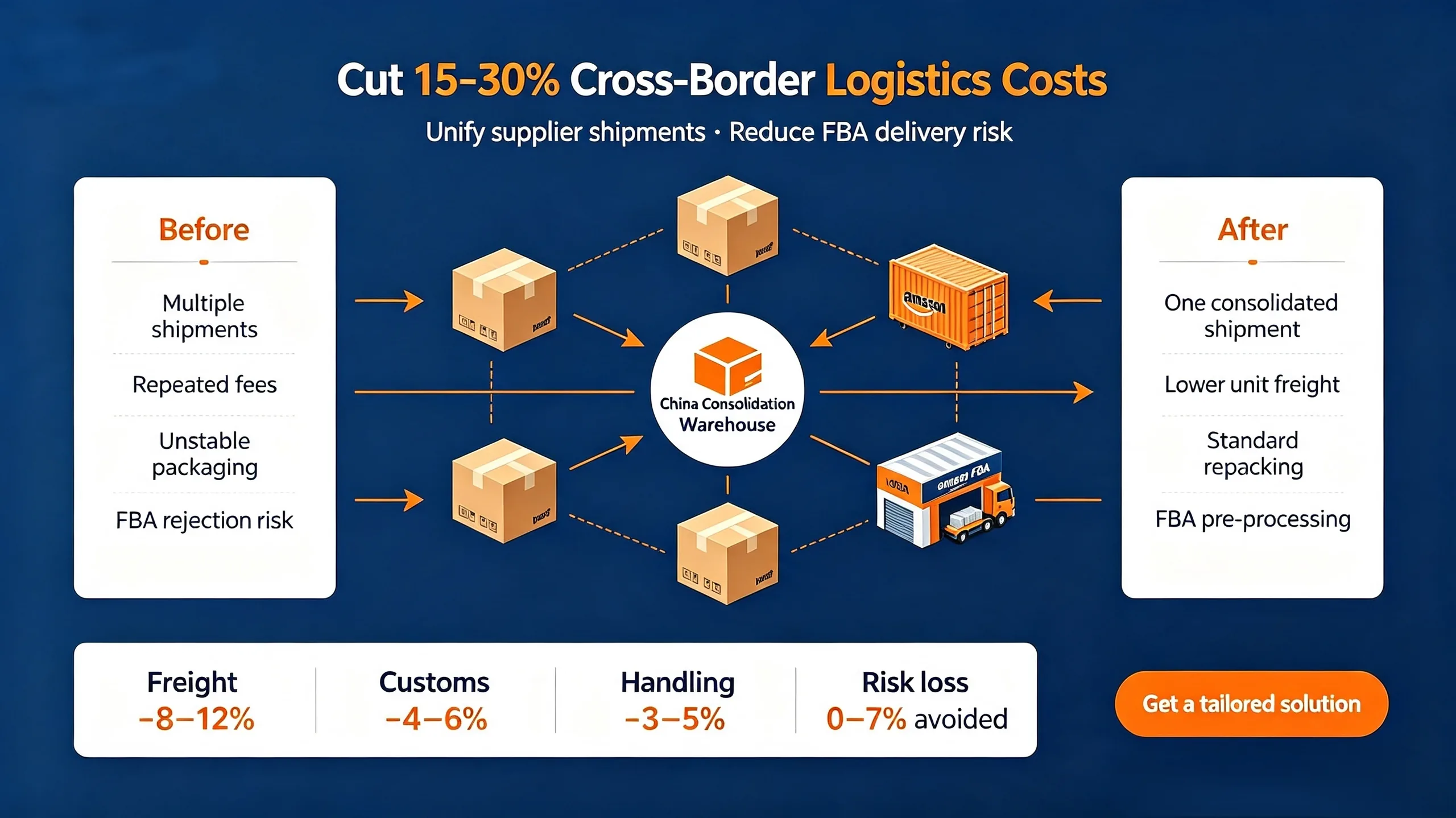
A professional China consolidation warehouse cuts 15–30% of cross-border logistics costs, unifies scattered supplier shipments, and reduces Amazon FBA delivery risks for global sellers.
1. What is a China consolidation warehouse?
A China consolidation warehouse is a domestic transit storage facility operated by logistics providers such as Easy China Warehouse (ECW). It collects, stores, sorts, and repackages goods from multiple Chinese suppliers. It combines separate small-batch orders into one unified shipment for international delivery.
Two core logistics terms apply here. Less than Container Load (LCL) refers to shipments that do not fill an entire ocean container. Full Container Load (FCL) means goods occupy a complete shipping container. Sellers can switch flexibly between LCL and FCL based on cargo volume.
2. Why do cross-border sellers need cargo consolidation services?
Most Amazon FBA and DTC sellers source goods from 3 to 8 Chinese suppliers. Separate shipments cause repeated freight fees, multiple customs clearance charges and extra handling costs. This fragmented shipping mode also raises risks of delivery delays, parcel loss and Amazon FBA warehouse rejection.
Cargo consolidation solves all these issues. The warehouse unifies all supplier cargo into one shipment, standardizes packaging rules and fixes delivery schedules. It eliminates repeated logistics operations and stabilizes inbound quality for overseas warehouses.
3. What core costs can sellers save via consolidation warehousing?
Cargo consolidation reduces redundant logistics expenses in four key areas. The structured comparison below clearly shows the cost advantages for cross-border businesses.
|
Cost Item |
Separate Supplier Shipping |
Consolidated Warehouse Shipping |
Cost Saving Effect |
|
Basic Freight Fee |
High unit price for small batch LCL shipments |
Combined cargo lowers unit freight rate |
Save 8–12% of ocean/air freight |
|
Customs Clearance Fee |
Multiple clearance charges for multiple shipments |
One-time unified customs clearance |
Save 4–6% of clearance costs |
|
Handling & Packaging Fee |
Repeated sorting and packaging by each factory |
One-time standardized repackaging |
Save 3–5% of operational costs |
|
Risk Loss Cost |
High risk of delay, damage and FBA rejection |
Unified inspection stabilizes cargo quality |
Avoid 0–7% of unexpected loss |
4. What risks can a China consolidation warehouse avoid?
Fragmented multi-supplier shipping brings hidden operational risks that increase seller’s loss. Professional consolidation services standardize every process to control risks effectively.
First, it avoids inconsistent packaging standards from different factories, which is a main cause of Amazon FBA inbound rejection. Second, unified cargo inspection reduces goods damage and missing problems. Third, fixed unified delivery schedules eliminate staggered shipment delays that affect store inventory restocking.
5. FAQ About China Cargo Consolidation
Q1: Is consolidation service suitable for small-batch frequent shipments?
Yes. It is the most cost-effective choice for sellers with 3+ suppliers and irregular small orders. It avoids high LCL unit costs of separate shipping.
Q2: Will cargo consolidation cause delivery delays?
No. Formal warehouses such as Easy China Warehouse set fixed weekly shipping schedules. Sellers can reserve warehousing space in advance to ensure on-time delivery.
Q3: Can the warehouse support FNSKU labeling and FBA pre-processing?
Yes. Professional consolidation warehouses provide customized FNSKU labeling, carton sorting, damage inspection and other FBA pre-processing services to meet Amazon’s inbound rules.
Q4: What cargo types support consolidation shipping?
Most conventional cross-border goods are supported, including daily necessities, electronic accessories, home goods and apparel. Special goods such as liquid and battery products need customized verification.
Q5: How much time can consolidation warehousing save for sellers?
It saves 80% of the time spent on docking multiple factories, tracking separate shipments and handling repeated logistics communications.
Final Thought
Cargo consolidation is one of the most practical ways to optimize your cross-border shipping structure and cut hidden logistics costs, yet most multi-supplier sellers do not maximize its value. Our ECW warehouse consolidation service centralizes scattered inventory, standardizes FBA pre-processing procedures, and unifies international shipments, delivering stable savings and lower risks for all your Amazon FBA and global fulfillment orders.
Start consolidating your multi-vendor cargo for your next inbound shipment! If you need cost evaluation, custom consolidation schedules, or professional pre-shipment inspection support, our operational team is ready to assist you anytime.
For tailored China cargo consolidation and reliable global shipping solutions, reach us: [email protected]
Follow our blog for more actionable cross-border logistics cost-saving and risk-mitigation tips!