
A shipment of 4,000 units lands at ONT8. The master cartons are clean, the box IDs scan, the pallet labels are on all four sides. Inside, every unit still carries the factory UPC. Amazon flags the shipment as Label missing – product related, applies FNSKU stickers itself, bills the seller per unit, and the inventory sits in receiving for eleven days while the listing runs out of stock.
Nothing about that shipment was cheap to fix. The labeling itself took minutes. The delay, the per-unit fee, and the defect on the Inbound Performance dashboard took weeks to work off.
Labeling is the part of FBA prep that fails most often and costs most per mistake, because it fails at the unit level — 4,000 small errors, not one big one. And in 2026 the rules around it changed twice. Most guides still describe the pre-2026 version.
Two rule changes in 2026 that redefined “correctly labeled”
The first change is who has to label at all. As of March 31, 2026, Amazon’s barcode requirements changed: brand owners can keep using manufacturer barcodes (UPC, EAN, JAN, ISBN) without applying stickers, but resellers must apply Amazon barcodes even when a manufacturer barcode exists on the product. Before this change, a reseller selling a product that already carried a scannable UPC could ship it stickerless. That door is closed.
The second change is who does the work. Amazon no longer treats prep as a service sellers can order. What remains is the unplanned path: if a shipment arrives without the required label or prep, Amazon processes it at your cost, per unit, and the rate climbs with your coaching level. It is not a service. It is a penalty with a price list.
| Who you are | What barcode the unit needs | Do you need FNSKU stickers? |
|---|---|---|
| Brand owner (Brand Registry) | Manufacturer barcode is acceptable | No, if the barcode is physical and scannable |
| Reseller | Amazon barcode (X00 / FNSKU) | Yes, even if a UPC is present |
| Any seller, commingled inventory | FNSKU required to keep your units separate | Yes |
| Any seller, used condition | Amazon barcode | Yes |
If you are a brand owner shipping your own production, the March change saved you a step. If you buy branded goods and resell them, it added one — and it is the step most Chinese prep lines still skip, because the factory UPC is already there and looks sufficient.
The FNSKU label specs Amazon actually enforces
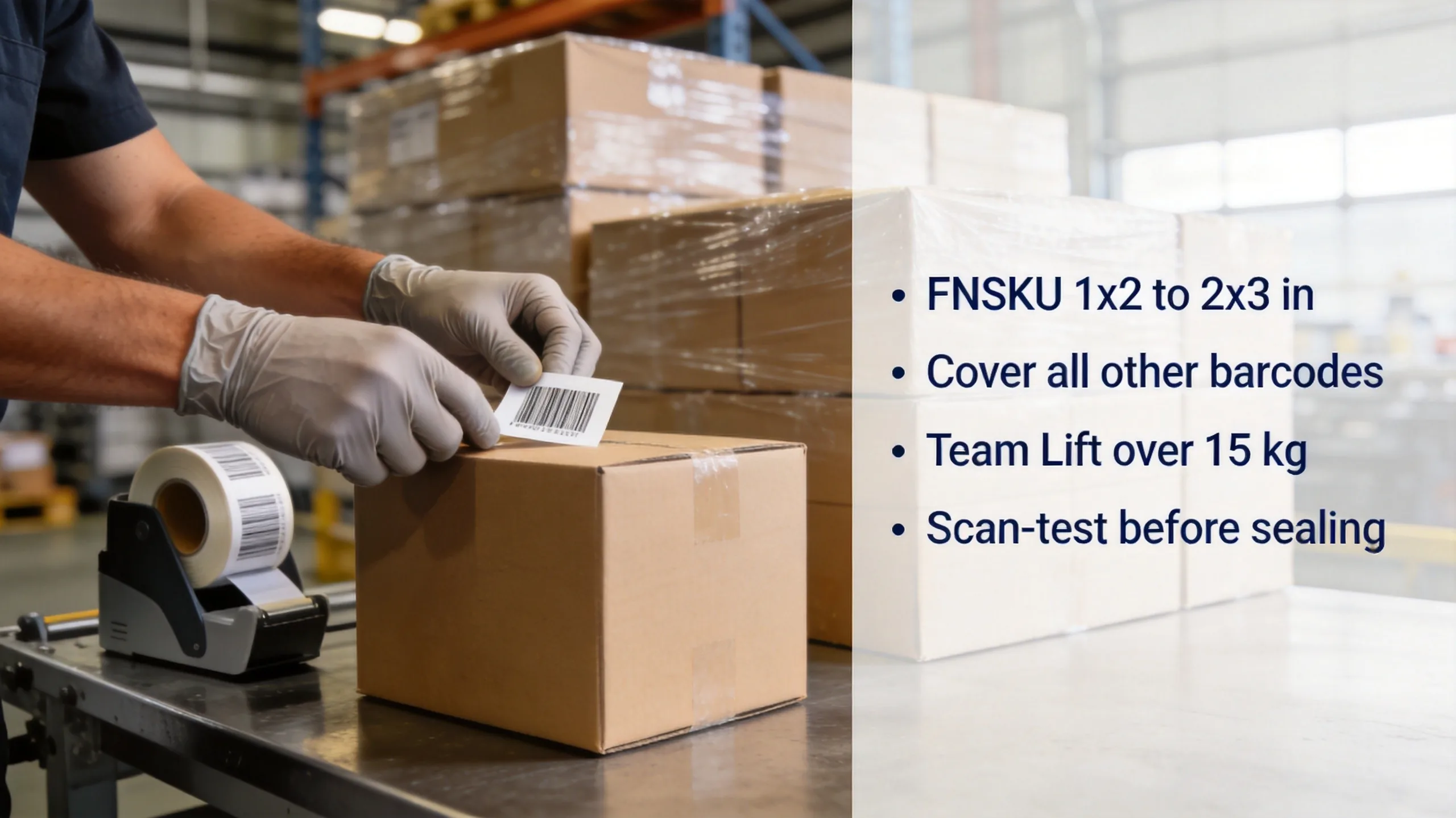
Amazon publishes a full spec sheet, and the fulfillment center enforces it with a scanner, not a ruler. These are the numbers that matter:
| Spec | Requirement | How it fails in practice |
|---|---|---|
| Label size | Between 1” × 2” and 2” × 3” (25.4 × 50.8 mm to 50.8 × 76.2 mm) | Oversized labels fold over edges on small units |
| Quiet zone | 0.25” on the sides, 0.125” above and below the barcode | Labels printed edge-to-edge scan unreliably |
| Margin to packaging edge | 0.25” between label edge and packaging edge | Corners peel during handling and lose the barcode |
| Content | Barcode plus FNSKU or ASIN, product title, item condition | Labels reprinted from a different listing mislabel the unit |
| Material | Black ink on white, non-reflective label with removable adhesive | Glossy stock reflects scanner light and fails |
| Print quality | 300 DPI or higher; thermal or laser, never inkjet | Inkjet smears; low ink produces unscannable bars |
| Durability | Readable and scannable for 24 months | Direct thermal labels fade in hot containers |
That last row is the one people underestimate. A container crossing the Pacific in July reaches interior temperatures that will bleach a cheap direct-thermal label into a blank rectangle. The label scanned fine in Shenzhen. It does not scan in Ontario, California.
Placement: what the label must cover, and what it must never cover
Placement causes more defects than print quality, because it depends on whoever is holding the unit. The rules are short:
- Cover every other visible barcode on the unit — UPC, EAN, ISBN, factory codes. The only exceptions are serial-number barcodes and Transparency codes, which must stay visible and must never be covered or be used to cover something else.
- Do not cover existing stickers or labels that carry warnings, safety information, or compliance marks.
- Place on a flat surface, never on a curve, seam, or corner.
- On cylindrical products, place the label vertically so the scanner reads along the axis instead of around it.
- If the unit is bagged or bubble-wrapped, the label goes on the outside of the prep material, not on the product underneath it.
- In a case pack, every unit inside needs its own barcode, and every barcode on the outer case must be removed or covered.
One more that gets missed: poly bags with an opening of 5 inches or more need a suffocation warning, printed on the bag or applied as a label, in a font size legible for that bag. It sits in the same defect group as missing barcodes and is charged the same way.
Carton marks: the box level where shipments get refused
Unit labels get you scanned. Carton marks get you received. Every box needs its own unique FBA shipment ID label, printed from the shipping queue — never photocopied, reused, or edited for another box. Pallets need four labels, one at the top center of each side, in addition to the label on every box on the pallet. If you are still mapping the rest of the inbound requirements, our guide to Amazon FBA shipping requirements covers the prep and documentation side.
Labels go on a flat surface, not over a seam, an opening, or an edge. A box ID that folds across the flap gets torn the moment someone opens the carton, and an unscannable box ID escalates your coaching level at the shipment level.
Weight and dimension limits differ between marketplaces, and this is where sellers shipping to both the US and Europe get caught:
| Item | United States | Europe |
|---|---|---|
| Standard box weight cap | 50 lb (22.7 kg) | 23 kg |
| Team Lift label threshold | Any box over 50 lb | Any box over 15 kg |
| Mechanical Lift label | Single-unit boxes over 100 lb | Governed by the Heavy and Bulky programme |
| Number of safety labels | Visible on top and all sides | 5 labels: top plus four sides |
| Standard box dimensions | Any side up to 25” (63.5 cm) | Min 15.2 × 10.0 × 2.5 cm, max 63.5 cm per side |
| Over 30 kg | Restricted | Heavy and Bulky programme: max 150 cm length, max 3 m girth |
Amazon does not supply Team Lift or Heavy Package labels. You generate them yourself, and they must be in the language of the destination country. A box marked “TEAM LIFT” in English arriving at a German fulfillment center is not marked.
The defect types that trigger per-unit charges
Amazon tracks inbound problems in the Inbound Performance dashboard over a rolling 120-day window, grouped by problem type. Labeling problems fall into four groups, and all four are charged per unit:
| Problem group | What it looks like | Charged |
|---|---|---|
| Label missing – product related | No Amazon barcode, no manufacturer barcode, or no suffocation warning | Per unit |
| Incorrect label – product related | Unit mislabeled, barcode smudged, or barcode hidden under prep | Per unit |
| Other labeling problems | Label fell off, low ink, or the wrong FNSKU entirely | Per unit |
| Label missing – box related | No shipment ID label, or an unscannable one | Shipment level |
The fee rate is not fixed. It moves through three coaching levels — Standard, Elevated, Critical — based on how long your problem rate stays above the acceptable threshold for that group. Standard applies below the threshold or for fewer than 21 days. Elevated kicks in past 21 days. Critical follows another 21 days above the threshold at Elevated.
Critical is where the cost stops being money. At Critical, Amazon can suspend your ability to choose the prep owner or label owner for the affected FNSKUs and perform the prep and labeling itself, charging per unit. You lose control of your own supply chain process until your 120-day rate drops back below acceptable.
For a reseller shipping 4,000 units a month, one systematic labeling error compounds across every shipment created during that window. That is how a labeling mistake becomes a supply chain problem.
Why labeling in China beats labeling at the destination
The argument is not about the cost per sticker. It is about when the error is discovered.
Labeled in Shenzhen, a wrong FNSKU is caught at the packing table, before the carton is sealed, by someone who can reprint and relabel in ten minutes. Labeled at a US prep center, the same error is caught by Amazon, in receiving, after the container has crossed an ocean — and the fix now involves either an unplanned service fee plus a receiving delay, or pulling inventory back out of the fulfillment network.
Three structural differences follow from that timing:
- Rework cost. A mislabeled unit in China is a sticker. A mislabeled unit in the US is a unit that has to be located, pulled, relabeled, and resubmitted — assuming it has not already been sold under the wrong FNSKU.
- Time to fix. Ocean transit runs 30 to 40 days to the US. If labeling is done at origin, the error window closes before the container leaves. If it is done at destination, the error window stays open for the entire transit.
- Who owns the risk. Amazon’s position on third-party prep errors is unambiguous: the seller carries it. If your prep center mislabels, that is between you and the prep center. The defect lands on your account.
There is a second reason that has nothing to do with errors: consolidation. When labeling happens at a China warehouse that is also receiving goods from multiple factories, the units get labeled during consolidation instead of in a separate pass. You are not paying for a labeling step. You are paying for a handling step that now includes labeling.
A pre-shipment labeling checklist
Run this before the container is sealed. Every item maps to a defect group above.
- Confirm which barcode type each SKU requires under the March 2026 rules — brand owner or reseller.
- Verify the printed FNSKU matches the ASIN, the product title, and the condition on the label.
- Measure one label per SKU: is it within 1” × 2” to 2” × 3”?
- Check the quiet zone — 0.25” on the sides, 0.125” top and bottom.
- Confirm every other visible barcode on the unit is covered, except serial and Transparency codes.
- Confirm no warning, safety, or compliance label has been covered.
- Confirm labels sit on flat surfaces, not corners, seams, or curves. Cylindrical units: vertical placement.
- If bagged or wrapped, confirm the label is on the outside of the prep material.
- Confirm poly bags with a 5-inch or larger opening carry a suffocation warning.
- Weigh every carton and compare against the destination threshold — 50 lb for the US, 15 kg for the Europe Team Lift trigger.
- Confirm Team Lift or Heavy Package labels are applied in the destination language, on the top and all four sides.
- Confirm every carton has its own unique shipment ID label, printed fresh, none photocopied, none placed over a seam.
- Scan-test a sample at the packing table with the same scanner type the fulfillment center uses.
Item 13 is the one that catches problems items 1 through 12 miss. A label can meet every published spec and still fail a scanner.
How we handle it at our Shenzhen warehouse
Labeling is one of the value-added services we run inside the warehouse, which means it happens on the same handling pass as receiving, QC, and consolidation — not as a separate trip to a prep center.
What that covers in practice: FNSKU printing and application per unit, covering or removing factory barcodes, carton marks and shipment ID labels, Team Lift and Heavy Package labels in the destination language, suffocation warnings on poly bags, and an AQL spot check with photo documentation before the carton is sealed. If you are shipping to Amazon, we also handle the FBA shipment booking and delivery to the fulfillment center, so the same team that labeled the units is the team that books the appointment.
For sellers consolidating from several factories, labeling during warehouse receiving and consolidation usually removes an entire handling step from the cost structure. For an itemized view of what prep and labeling add to a shipment, see our breakdown of what FBA prep services cost. For the freight side of the same shipment, see what it costs to ship to Amazon FBA.
One thing labeling in China cannot fix: US customs. If the “ship to” field on your FBA labels carries a company name, CBP may ask for the importer tax number that matches it, and no amount of correct FNSKU work will clear that. We covered that separately in this notice on FBA labels and customs clearance.
Frequently asked questions
If I am brand registered, do I still need FNSKU labels?
Not necessarily. Since March 31, 2026, brand owners can use manufacturer barcodes without stickers, provided the barcode is physical and scannable on the unit. If you use commingled inventory and want your units tracked to your account, apply FNSKU labels anyway.
I am a reseller and the product already has a UPC. Do I still need to label?
Yes. That is exactly what changed on March 31, 2026. Resellers must apply Amazon barcodes even when a manufacturer barcode exists on the product.
Does Amazon still label products for me?
Only through the unplanned service path, at your cost, per unit. Amazon flags the item as a defect, applies the label, charges the fee, and records it against your Inbound Performance dashboard. Repeated defects escalate your coaching level and can eventually remove your ability to choose your own prep and label provider.
My carton weighs 16 kg. What do I need?
For Europe, any box over 15 kg needs a Team Lift or Heavy Package label on the top and all four sides — five labels total — in the destination country’s language. For the US, the trigger is 50 lb (22.7 kg). Check the destination marketplace before you seal the carton, because a box that is compliant for one is not compliant for the other.
Can the FNSKU cover the original UPC?
It must. Every other visible barcode on the unit has to be covered or removed, so the scanner reads the FNSKU and nothing else. The exceptions are serial-number barcodes and Transparency codes, which must remain visible.
Will labeling in China cause customs problems?
No. Unit barcodes are not a customs document. What can cause clearance problems is a company name in the “ship to” field on the FBA label, which CBP may want matched to an importer tax number. That is a separate issue from labeling and is handled by keeping the company name off the label.
How do I know my labels will still scan after 30 days in a container?
Use thermal transfer or laser printing on white non-reflective stock rated for 24-month readability, not cheap direct thermal. Then scan-test a sample with the scanner type used at the fulfillment center. Heat and humidity in a summer container will fade a direct thermal label to blank.
Labeling is the cheapest thing to get right
The sticker costs almost nothing. The defect costs per unit, delays receiving, and at scale removes your control over your own prep process. It is the one part of FBA prep where the cost of being wrong is orders of magnitude higher than the cost of being careful.
If you are shipping from China and want labeling handled before the carton is sealed, send us your SKU list and destination marketplace. We will confirm the barcode type each SKU needs under the 2026 rules and quote the labeling as part of the shipment, not as a separate service.
Request a quote — include your carton count, units per carton, and whether you are a brand owner or reseller.