
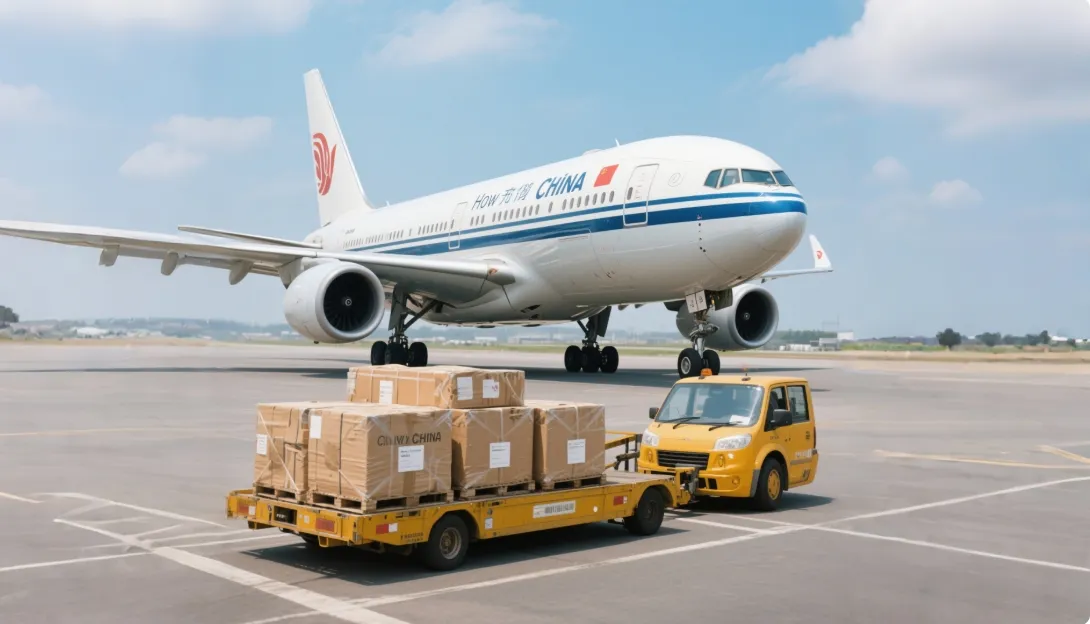
Air freight from China is the right choice when the cost of waiting exceeds the cost of flying. It is more expensive per kilogram than sea freight and cheaper than retail express, and it sits in a gap that suits e-commerce restocking well: too urgent for a container, too big for a courier. This guide covers how the process works, what actually drives the price, and how to bring that price down.
Air freight, express and sea freight compared
These three are often discussed as if they were interchangeable. They are not, and picking the wrong one is where most of the money is lost.
| Air freight | Express courier | Sea freight | |
|---|---|---|---|
| Typical use | Restocking, mid-size urgent loads | Samples, small urgent parcels | Bulk inventory |
| Speed | Days | Fastest | Weeks |
| Cost per kg | Between the other two | Highest | Lowest |
| Scope | Airport to airport unless you buy door to door | Door to door, clearance included | Port to port unless you buy door to door |
| Volumetric divisor | Commonly 6,000 | Commonly 5,000 | Charged by volume or weight |
That last row is worth understanding before you compare any quotes, because it is where two apparently similar offers stop being comparable.
How air freight is priced
Carriers bill on chargeable weight, which is the greater of the actual weight and the volumetric weight. Volumetric weight is the shipment’s volume in cubic centimetres divided by a fixed divisor: air cargo commonly uses 6,000, while express integrators commonly use 5,000. A lower divisor produces a higher billed weight for the same box, which is one reason express costs more than its headline rate suggests.
The practical consequence is that packaging is a pricing decision. If your cargo is light and bulky, you are paying for air, not for goods. Reducing carton dimensions, removing void fill and flat-packing where possible often cuts an air freight bill more than negotiating the rate does.
Beyond chargeable weight, the price moves with fuel and security surcharges, seasonal demand around peak retail and Chinese New Year, the airport pair and whether the routing is direct, and the destination charges and duty waiting at the other end. Rates move week to week, so treat any figure you find published online as a snapshot rather than a quote.
How to ship from China by air, step by step
- Appoint a forwarder. Airlines sell capacity to freight forwarders in volume. A forwarder with real density on your lane buys better than you can and handles the parts that follow.
- Confirm what the quote covers. Air freight is quoted airport to airport by default. Establish whether pickup from your supplier, export clearance, destination clearance, duty and final delivery are included, because a door-to-door price and an airport-to-airport price are not comparable numbers.
- Prepare the cargo. Sturdy but light packaging to control volumetric weight, clear labelling and barcodes, and cartons palletised as your forwarder specifies.
- Get the documents right. A commercial invoice, packing list and air waybill at minimum, with accurate HS codes and declared values. Most air freight delays are documentation problems, not flight problems.
- Export and import clearance. Your forwarder handles China export customs and, if contracted to, the destination entry.
- Track and take delivery. Air shipments are tracked by air waybill. Arrange onward delivery from the destination airport unless door to door was included.
Customs: what changed
The $800 de minimis exemption that once let low-value shipments into the US duty-free has been suspended. It ended for goods of Chinese and Hong Kong origin on 2 May 2025, was extended to all countries from 29 August 2025 under Executive Order 14324, was continued by Executive Order 14388 in February 2026, and was made indefinite by two CBP interim final rules effective 24 June 2026. It is repealed in statute from 1 July 2027.
For air freight this means duty and a customs entry are now part of every shipment’s cost, not an occasional extra. Build them into your comparison from the start. See our guide to the cheapest way to ship from China to the USA for how this changes the overall arithmetic.
How to make air freight cheaper
- Attack volumetric weight first. It is the single largest controllable input. Measure your cartons and calculate chargeable weight before you book.
- Consolidate. One larger shipment beats several small ones on rate and on entry costs. Consolidation is the standard route to better air pricing for smaller sellers.
- Be flexible on timing. Deferred air freight trades a little speed for a lower rate, and avoiding peak season avoids surcharges.
- Book earlier. Most expensive air freight is bought to rescue a late production run. Lead time is the cheapest lever available.
- Use a forwarder’s contracted rates. Retail express counter pricing is the most expensive way to move goods out of China.
- Split the mode. Fly what you need now, ship the rest by sea. A hybrid split usually beats committing the whole order to either mode.
Frequently asked questions
How long does air freight from China take?
Air freight moves in days rather than the weeks sea freight takes, but the door-to-door time depends on the airport pair, whether the routing is direct, space availability at the time of booking, and how quickly customs clearance is completed at destination. Carriers do not publish reliable lane-by-lane transit times, so ask your forwarder for the current figure on your actual route.
How much does air freight from China cost?
Air freight is priced on chargeable weight, which is the greater of actual weight and volumetric weight, then adjusted for fuel and security surcharges, seasonal demand and the specific route. Because rates move week to week, published figures date quickly. Get a live quote against your real cartons and destination, and make sure it states whether duty and delivery are included.
What is the difference between air freight and express shipping?
Express couriers such as DHL, FedEx and UPS offer a door-to-door service with customs clearance built in, at the highest cost per kilogram. Air freight is normally sold airport to airport, is cheaper per kilogram, and suits larger consignments. They also use different volumetric divisors, commonly 5,000 for express and 6,000 for air cargo, so the same carton is billed at a higher weight by express.
How is chargeable weight calculated for air freight?
Take the shipment’s volume in cubic centimetres and divide it by the applicable divisor, commonly 6,000 for air cargo. Compare that figure with the actual weight, and you are billed on whichever is greater. Light bulky cargo is therefore charged on its size, which is why reducing carton dimensions directly reduces the bill.
When should I use air freight instead of sea freight?
Use air when the cost of waiting is higher than the cost of flying: urgent restocks, high-value goods where a month of transit ties up too much cash, product launches, and any situation where a stockout would cost more than the freight premium. Use sea for bulk inventory ordered with enough lead time. Many sellers run both, flying urgent replenishment and shipping the bulk by sea.
Do I pay duty on air freight shipments from China?
Yes. With the $800 de minimis exemption suspended, value no longer exempts a shipment from duty, and every shipment requires a customs entry. What you owe depends on the HS classification of your goods and their country of origin. Confirm whether your air freight quote includes duty and destination charges or whether they will be billed separately.
Air freight from China with Easy China Warehouse
We book air freight out of China for e-commerce sellers and businesses shipping worldwide, including consolidation for smaller loads, the customs entry now required on every import, and door-to-door delivery so you are not left arranging collection at an airport. We can also hold stock in our China warehouse and release it by air when you need it.
See our freight forwarding services or contact us for a free quote on your next air shipment.