

The cheapest way to ship from China to the USA is sea freight once your shipment passes roughly 100 kg or 2 CBM, and consolidated air or express below that. That much has not changed. What has changed is that freight is no longer the biggest number on your invoice. Since the $800 de minimis exemption was suspended, every shipment needs a customs entry and is liable for duty, so the cheapest freight rate and the cheapest landed cost are often two different answers.
The short answer, by shipment size
| Your shipment | Usually cheapest | What you give up |
|---|---|---|
| A few parcels, under ~20 kg total | Consolidated express through a forwarder | Little. Going direct with a carrier at retail rates costs more. |
| 20–100 kg | Air freight, consolidated | Airport-to-airport only. You still need clearance and delivery. |
| 100 kg to ~15 CBM | Sea freight LCL | Weeks instead of days, and you share a container. |
| 15 CBM and up | Sea freight FCL | Slowest option, but the lowest cost per unit by a wide margin. |
| Urgent, any size | Express | The most expensive per kg, but no cheaper option is fast. |
Those bands are about physics and they hold year to year. The part that moves is what happens when the goods reach US customs, and that is where most advice written before 2025 is now wrong.
What changed: the $800 de minimis exemption is gone
For years the standard advice for small shipments was to stay under $800 per parcel and clear duty-free under the de minimis exemption. That route is closed.
- 2 May 2025 — de minimis treatment ended for goods of Chinese and Hong Kong origin.
- 29 August 2025 — Executive Order 14324 extended the suspension to all countries.
- 20 February 2026 — Executive Order 14388 continued the suspension.
- 24 June 2026 — two CBP interim final rules made the suspension indefinite, covering both the international postal network and every other mode of transport.
- 1 July 2027 — the exemption is repealed in statute under the One Big Beautiful Bill Act, enacted 4 July 2025.
The practical effect for anyone importing from China: a $200 parcel and a $2,000 parcel both need a customs entry, and both owe duty. Splitting an order into smaller parcels to duck the old threshold no longer saves anything. It now multiplies your entry paperwork.
Be careful with older guides on this, including some published recently. A number of summaries state that only non-postal shipments lost the exemption. Both modes are covered by the June 2026 rules.
What you actually pay
Landed cost has four parts. Quotes that look cheap usually quote only the first.
- Freight. The rate to move the goods. This is the number most people compare, and it is rarely the largest.
- Duty and fees. Driven by your HTS code and country of origin, not by which carrier you pick. On low-value goods this now routinely exceeds the freight cost.
- Customs entry and brokerage. Now unavoidable on every shipment. A per-entry cost, which is why consolidating into one entry beats many small ones.
- Destination handling and last mile. Port or airport charges, then delivery. Easy to forget when comparing port-to-port rates against door-to-door ones.
Two quotes are only comparable if they cover the same span. Port-to-port against door-to-door is not a real comparison, and it is the single most common way importers pick the more expensive option believing it is cheaper.
Volumetric weight catches people out
Air and express carriers charge on whichever is greater: actual weight, or volumetric weight, calculated as length × width × height in centimetres divided by 5,000. Light bulky goods therefore cost far more than the scale suggests. Reducing carton size often cuts an air or express bill more than negotiating the rate does.
Sea freight: cheapest per unit at volume
For anything of real size, sea freight wins on cost and nothing else comes close. The choice is between sharing a container and booking your own.
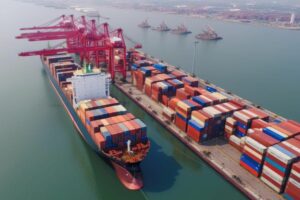
LCL (Less than Container Load) means your cargo is consolidated with other shippers’. You pay for the space you use, which makes it the entry point for smaller volumes. The trade-offs are real: consolidation and deconsolidation add days at both ends, and your goods move at the pace of the slowest consignment in the box.
FCL (Full Container Load) means the container is yours. Once you are filling most of a container, FCL is usually cheaper per unit than LCL for the same goods, and it is simpler because nothing waits on other shippers. The common mistake is staying on LCL out of habit past the point where a full container would have cost less in total.
Ask your forwarder to price both at your actual volume. The crossover point moves with market rates, so a rule of thumb from last year is not reliable this year.
Air freight: when it is genuinely the cheaper choice
Air freight costs more per kilogram than sea, so on a pure rate comparison it always loses. That comparison is often the wrong one.
Air becomes the cheaper option in total when the shipment is small enough that sea freight’s fixed costs dominate, when goods are high value relative to their weight and tying up cash in a month of transit costs more than the freight difference, or when a stockout would cost more than the premium. For sellers replenishing fast-moving inventory, running out is usually more expensive than flying it in.
To get air freight cheaper: consolidate rather than shipping small lots repeatedly, be flexible on departure dates, book through a forwarder with volume on the lane rather than at published rates, and cut volumetric weight before negotiating anything.
Express couriers: fastest, most expensive, sometimes correct
DHL, UPS and FedEx are door to door with clearance included, which is genuinely convenient. Retail counter rates are the most expensive way to move goods from China. Forwarder-negotiated express accounts are substantially cheaper for the same service, which is why express through a forwarder appears in the table above and direct express does not.
Express earns its cost for samples, urgent replenishment, and small high-value goods. It is a poor default for routine inventory.
Postal and ePacket: what happened to it
ePacket and registered air mail were built around duty-free low-value parcels. With de minimis suspended for postal shipments too, the economics that made them attractive no longer apply, and postal parcels now go through a customs entry process like everything else. If you are following advice that recommends ePacket for cheap US-bound shipping, that advice predates the rule change.
Seven ways to cut what you pay
- Consolidate. One shipment and one entry beats several. This matters more now that every shipment needs an entry.
- Plan production earlier. Lead time is the cheapest lever you have. Most expensive shipping is bought to fix a late order.
- Attack volumetric weight. Smaller cartons and better packing cut air and express costs directly.
- Get your HTS classification right. Duty is now a major line item. The wrong code means overpaying, or a penalty for underpaying.
- Agree Incoterms before the goods ship. Settle who pays duty, freight and handling with your factory up front. Disputes here are expensive and slow.
- Compare like for like. Insist every quote covers the same scope, door to door, with duty and destination charges included.
- Use a forwarder with real volume on your lane. They buy space cheaper than you can and handle the entry, which is now mandatory on every shipment.
Frequently asked questions
What is the cheapest way to ship from China to the USA?
Sea freight, for any shipment large enough to justify it, which in practice means roughly 100 kg or 2 CBM and up. Below that, consolidated air or express through a freight forwarder is normally cheaper than sea once you account for LCL’s fixed handling costs. Since the $800 de minimis exemption was suspended, compare total landed cost including duty and the customs entry, not the freight rate alone.
Is the $800 de minimis exemption still available for goods from China?
No. It ended for Chinese and Hong Kong origin goods on 2 May 2025, was suspended for all countries from 29 August 2025 under Executive Order 14324, was continued by Executive Order 14388 in February 2026, and was made indefinite by two CBP interim final rules effective 24 June 2026 covering both postal and non-postal modes. It is repealed in statute from 1 July 2027.
Is it cheaper to ship many small parcels or one large shipment?
One large shipment, in almost every case. Each shipment now requires its own customs entry, so splitting an order multiplies both entry costs and paperwork while forfeiting volume rates. The old tactic of splitting orders to stay under $800 per parcel no longer achieves anything.
How much cheaper is sea freight than air freight from China?
Sea is dramatically cheaper per kilogram at volume, but the gap depends on live market rates, your lane and the season, and both move considerably through the year. Any fixed multiple you see quoted is a snapshot. Ask for current quotes on your actual route and volume, and compare them on a door-to-door basis.
How long does sea freight take from China to the USA?
Transit time depends on the port pair, the service, and whether the routing is direct or transshipped, and schedules shift with congestion. Your forwarder can give you the current transit for your specific lane. As a planning principle, treat sea freight as a matter of weeks and air freight as a matter of days, and build your production timeline so you are not forced into the fast option.
Do I still pay duty on a low-value shipment?
Yes. With de minimis suspended, value no longer exempts a shipment from duty. What you owe is determined by the HTS classification of the goods and their country of origin. Getting the classification right is now a cost control measure, not just a compliance one.
Get a quote on your actual shipment
The cheapest option depends on your weight, volume, timeline and product classification, and rates move week to week. Easy China Warehouse consolidates shipments, handles the customs entry that is now required on every import, and quotes door to door so you can compare options on the same basis. Contact us for a quote on your next shipment from China.