
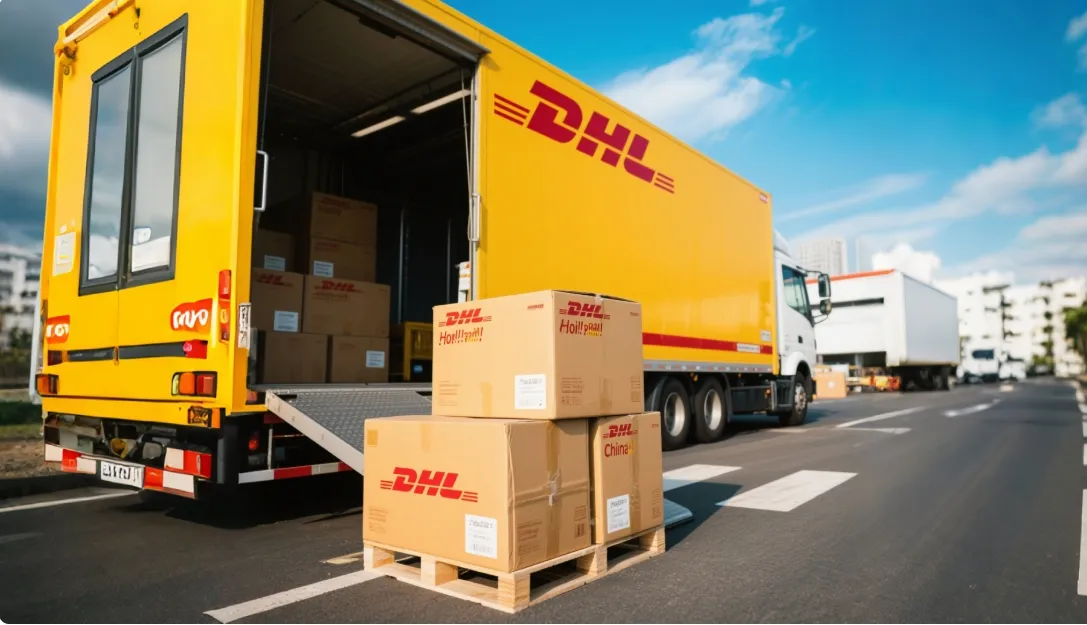
DHL is the carrier most China-based sellers reach for when the destination is Europe, and it is also the one whose invoice is hardest to predict, because DHL publishes its surcharges as a moving schedule rather than a fixed rate card. A parcel that costs the same in July can cost meaningfully more in November for reasons that have nothing to do with your product.
This guide covers what DHL actually offers from China, the service tiers that matter, the surcharge structure with the current published numbers, and the cases where another carrier is the better answer.
What DHL actually offers from China
DHL Express sells time-definite international services that differ almost entirely by delivery hour. The parcel moves on the same network; the price difference buys a commitment about when it lands.
| Service | Commitment | Use it when |
|---|---|---|
| DHL Express 9:00 | Next business day by 9:00 a.m. | A deadline that genuinely cannot move — production stoppage, contract penalty |
| DHL Express 10:30 | Next business day by 10:30 a.m. | Morning delivery needed, but an hour later is acceptable |
| DHL Express 12:00 | Next business day by noon | Same-day certainty at a lower premium |
| DHL Express Worldwide | End of business day | The default for commercial parcels and samples |
| DHL Economy Select | 2–5 business days, day-definite | Restocks where a date matters but the hour does not |
| DHL Express Envelope | Documents only, up to 0.5 kg | Paperwork, samples under the weight limit, nothing with commercial value |
Note what is missing: DHL has no economy ocean product, no consolidated air product, and no domestic US network to speak of. It is a parcel carrier for international express, and it is very good at that. It is not a substitute for a forwarder when the shipment is 300 kg or when the goods can wait three weeks.
DHL Express is not DHL eCommerce
This distinction costs sellers real money. DHL Express is the time-definite courier service described above: fast, tracked end to end, and priced per parcel. DHL eCommerce is a different product built for high-volume lightweight parcels, with slower transit, handoff to local postal or delivery partners at destination, and per-gram economics that suit a $15 product but not a $500 one.
If you are quoted a DHL rate that looks far below the express market, check which product it is. A “DHL” quote for a 500 g parcel at a third of the express price is almost certainly eCommerce, which means a different transit time, a different tracking experience and a different claims process.
What drives the invoice
Four components, and the fourth is the one that changes without notice.
| Component | What it is | Controllable? |
|---|---|---|
| Billed weight | The greater of actual and volumetric weight, calculated as length × width × height in cm ÷ 5,000 | Yes — carton dimensions are the lever |
| Base rate | Published rate less your negotiated discount | Partly — volume and account type |
| Fuel surcharge | A percentage of base rate, reset against fuel indices | No |
| Demand surcharge | A seasonal per-kg charge DHL activates during peak, applied on top of fuel | Only by shipping earlier |
The current demand surcharge, in numbers
DHL has published a demand surcharge running from 1 October 2026 until 5 February 2027. For time-definite international services from China and Hong Kong to the Americas, the published rate is 2.10 CNY per kg of billed weight, equivalent to about 2.25 USD per kg, with the fuel surcharge applied on top. Day-definite international services such as Economy Select carry a flat 0.15 USD per kg instead.
Put that in context. On a 20 kg parcel, the demand surcharge alone is around 42 CNY before fuel — roughly 45 USD cents per kg added to a rate that may be in the $8–14 per kg range. It is not the largest line on the invoice, but it is the one that appears without you changing anything, and it explains why a quote given in September does not hold in November.
Two practical implications. If you are planning Q4 inventory into Europe or the US, ship before the surcharge window where your cash flow allows, because the differential is real across hundreds of parcels. And if you are comparing a DHL quote against a UPS or FedEx quote, check that all three include their respective peak surcharges — a comparison at base rate is not a comparison.
Transit times from China
- China to Europe: 2–4 business days to major cities on Express Worldwide, with Germany, Netherlands, France and the UK the strongest lanes.
- China to the US: 2–4 business days to coastal metros, 4–6 to inland markets. DHL is competent here but its network depth is in Europe rather than the US.
- China to the Middle East and Africa: 3–5 business days, and DHL is often the only carrier with consistent coverage into secondary African markets.
Add clearance time on top. Since the US removed the de minimis exemption, every commercial shipment requires an entry, and a parcel held for a classification question does not show as delayed until it has already missed its date. For Europe, VAT and IOSS handling adds a step that is administrative rather than slow — provided your documentation is right.
DHL versus UPS and FedEx from China
| Dimension | DHL | UPS | FedEx |
|---|---|---|---|
| Strongest lane | Europe, Middle East, Africa | US | US |
| Time-definite options | 9:00, 10:30, 12:00, end of day | Express Plus, Express, Saver, end of day | Priority, Economy |
| Economy tier | Economy Select, 2–5 days | Worldwide Economy, 5–12 days | International Economy, 2–5 days |
| Peak surcharge | Published per-kg demand surcharge with defined window | Peak and demand, announced per season | Peak and demand, announced per season |
| Best for | Europe-bound parcels, documents, secondary markets | US parcels where Saver pricing wins | US high-value parcels needing priority |
Our guides to shipping from China via UPS and via FedEx cover those carriers in the same detail.
When DHL is the wrong choice
- Heavy shipments. Above roughly 100 kg, consolidated air through a forwarder is usually cheaper per kg, even with DHL doing the final delivery.
- Anything that can wait. Express costs multiples of ocean freight per kg. If the goods are not urgent, DHL is the most expensive way to move them.
- Bulky light products. Volumetric weight divided by 5,000 punishes volume, so pillows, bags and packaging ship expensively no matter their actual weight.
- US inland secondary markets. DHL’s US network is thinner than UPS or FedEx outside major metros, and that shows up as longer final-mile times rather than higher rates.
- Goods needing prep. Express assumes the parcel is ready to fly. Labelling, bundling and quality checks belong in a warehouse, not at the airport.
The restrictions that stop DHL shipments
- Batteries. Lithium cells need the correct UN number and test documentation. Standalone power banks are frequently refused on express; batteries installed in equipment are easier.
- Liquids, powders, cosmetics. Documentation-dependent and often restricted to specific services. Perfume and alcohol-based products are effectively prohibited by air.
- Branded goods. Counterfeit screening is aggressive. Carry authorisation letters if you sell licensed product.
- Solid wood packaging. Requires ISPM 15 heat treatment and a visible stamp. Plywood and cardboard do not.
How to cut DHL costs
- Shrink the carton. Cutting 5 cm from each dimension of a 50 × 40 × 40 cm carton removes about 4 kg of billed weight. On a per-kg rate, that is the single largest saving available to most sellers.
- Default to Worldwide, not 9:00. The hour-level services carry a real premium. Pay for them only when a customer has paid you for that certainty.
- Ship before the demand surcharge window opens. The published window runs October to early February. Q4 stock that ships in September avoids it entirely.
- Batch into commercial addresses. Residential and remote surcharges are per parcel, so consolidating to a warehouse removes a block of accessorials.
- Check the postcode before quoting. Remote area surcharges are defined by postcode list, and they are not always where you expect.
- Compare forwarder rates on the same service. Consolidators buy at a different tier. The all-in number, including fuel and demand surcharge, is the only comparison worth making.
Step by step: shipping from China via DHL
- Confirm the goods can fly. Battery, liquid and brand status first. A refused shipment at the hub is the most expensive outcome available.
- Measure the packed carton, not the spec sheet. Then compute volumetric weight and use whichever figure is greater.
- Pick the service against a real deadline. Worldwide by default, 9:00 or 10:30 only when the delivery hour is contractual.
- Prepare a commercial invoice that will survive scrutiny. Accurate description, HS code, unit value, country of origin. Undervaluing to reduce duty creates a customs problem that costs more than the duty.
- Confirm the importer of record. Under DDP that is you or your forwarder, and the duty is yours to fund. Under DAP the consignee pays on delivery, which produces angry customers.
- Track by exception, not by scan. Watch the clearance status. A parcel sitting in customs does not show as delayed until it has already missed the date.
- Reconcile the invoice against the booking. Billed weight and surcharge errors are common and correctable inside the dispute window.
Frequently asked questions
How long does DHL take from China to the US?
2–4 business days to coastal metros and 4–6 to inland markets on Express Worldwide. Door to door, add pickup and the US customs entry, which is now required for every commercial shipment since the de minimis exemption was removed.
Is DHL cheaper than UPS or FedEx from China?
On Europe-bound parcels, usually yes. On US-bound parcels, it is close and depends on the week and the surcharge cycle. The reliable approach is to hold two accounts and compare the all-in quote including fuel and demand surcharges per shipment.
What is the DHL demand surcharge?
A seasonal per-kg charge DHL activates during high-demand periods, applied on top of the fuel surcharge. The current published window runs from 1 October 2026 to 5 February 2027, at 2.10 CNY per kg for time-definite international services from China and Hong Kong to the Americas.
What is the difference between DHL Express and DHL eCommerce?
Express is the time-definite courier service with end-to-end tracking and per-parcel pricing. eCommerce is a separate product for high-volume lightweight parcels, with slower transit, handoff to local delivery partners and lower per-gram cost. If a DHL quote looks far below market, check which product it is.
Does DHL handle customs clearance?
Yes, DHL brokers its own entries in most markets and can act as importer of record under DDP arrangements. You still supply the commercial invoice, and duty remains your liability if you are the importer.
How is DHL charging weight calculated?
On the greater of actual and volumetric weight, where volumetric weight is length × width × height in centimetres divided by 5,000. A 60 × 50 × 40 cm carton bills at 24 kg regardless of its real weight.
Can I ship batteries from China via DHL?
Some battery shipments are accepted, depending on cell type, watt-hour rating and whether the battery is installed in equipment. Standalone lithium batteries are frequently refused. Confirm classification with the carrier before booking.
Working with Easy China Warehouse
Most sellers shipping out of China need express for the urgent top-up and something cheaper for everything else. We hold goods in our China warehouse, consolidate suppliers, handle prep and labelling, and route each shipment the cheapest way it can go — DHL for the Europe-bound parcel that must arrive Thursday, consolidated air or ocean for the bulk.
Because we buy on volume rather than on a single account, the express rate we pass on is typically below what a direct account gets on the same service, and the surcharges are quoted before you book rather than discovered on the invoice. Send us one recent carrier invoice and we will price the same shipment side by side.
Related reading: sea versus air freight, shipping from China to Europe, how freight forwarding works, and Amazon FBA shipping requirements.