
Saudi Arabia is one of the few markets where a shipment can leave Shenzhen in perfect condition, arrive on schedule, and then sit at Jeddah or Dammam for weeks — not because of freight, but because a certificate was filed too late, with the wrong HS code, or by a party that was never allowed to file it.
That is the SABER problem. And in 2026 it has become sharper: the platform moved to 12-digit customs codes, labeling rules tightened, and a certificate issued under last year’s assumptions may no longer clear this year’s shipment. For sellers shipping out of China, Middle East compliance now starts at the factory floor, not at the port.
This guide covers what SABER actually is, which certificate your product needs, what changed in 2026, what it costs, and where shipments typically fail — from the perspective of a seller moving goods out of a China warehouse.
SASO, SABER, PCoC, SCoC — four names, one system
Exporters routinely use these terms interchangeably. They are not interchangeable, and mixing them up is how applications get filed in the wrong place.
SASO — the Saudi Standards, Metrology and Quality Organization — is the regulator. It writes the technical regulations that define what a compliant product is.
SABER (saber.sa) is the online platform SASO uses to run the whole conformity process: registration, classification, application, payment, and certificate issuance. It is a gateway, not a certifier.
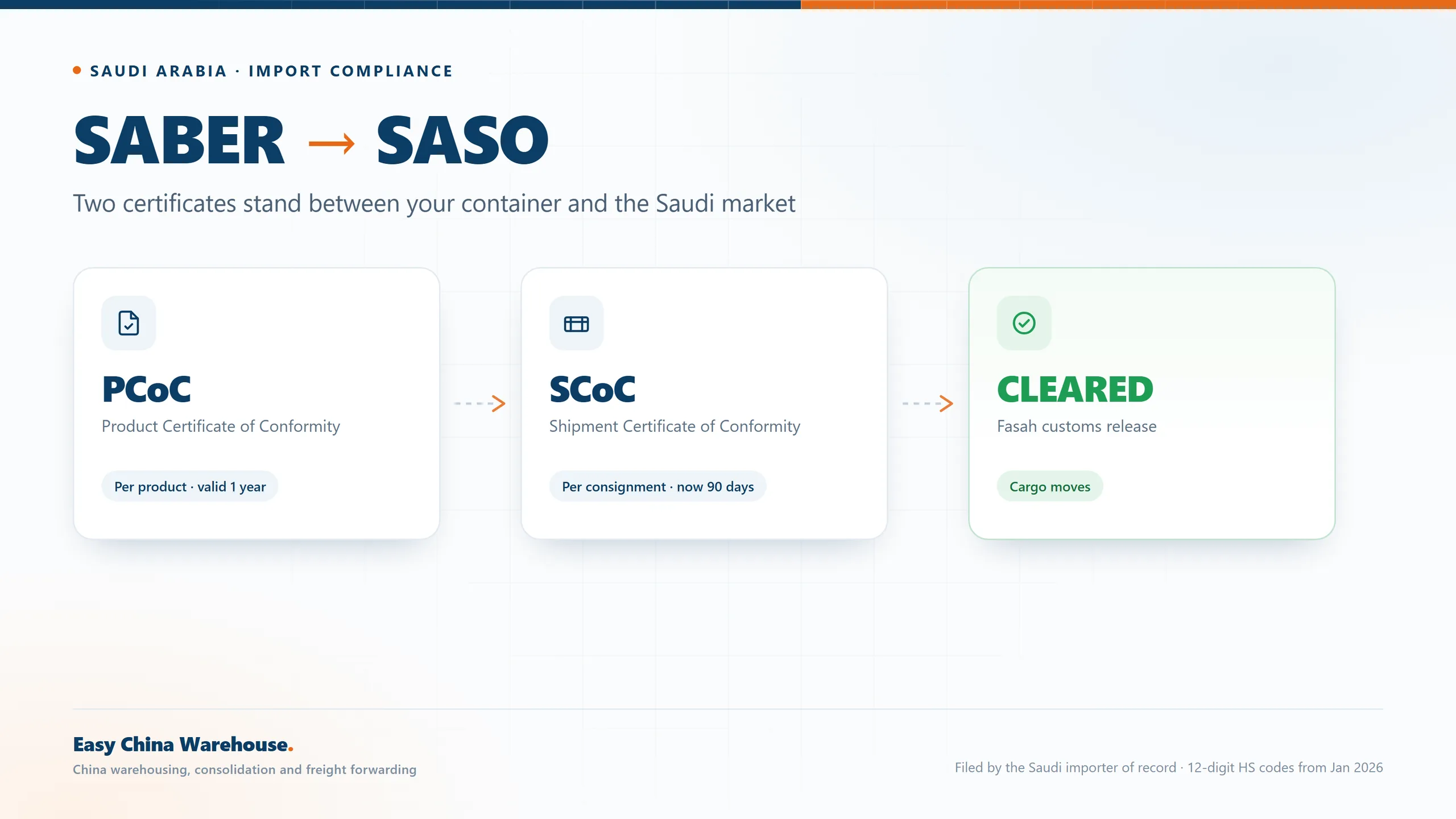
PCoC (Product Certificate of Conformity) is the product-level certificate. It proves a specific model meets the applicable technical regulation. One per product line, valid for one year.
SCoC (Shipment Certificate of Conformity) is the consignment-level certificate. It ties one actual shipment to a valid PCoC and is what Saudi Customs actually looks at when the container arrives.
| Term | What it is | Scope | Validity |
|---|---|---|---|
| SASO | The regulator and its technical regulations | National | — |
| SABER | The platform where applications are filed and certificates issued | National | — |
| PCoC | Product Certificate of Conformity | One product model | 1 year |
| SCoC | Shipment Certificate of Conformity | One shipment | One shipment, 90 days |
The one-line version: SASO makes the rules, SABER runs the paperwork, and the PCoC plus SCoC pair is what gets your container out of the port.
Who is allowed to file — and why the importer has to be Saudi
This is the part overseas sellers most often get wrong. A SABER commercial account requires a Saudi Commercial Registration (CR) number. A Chinese manufacturer or a foreign brand cannot register independently and file its own PCoC.
So compliance is never a solo job. The Saudi importer of record holds the account and files; the supplier provides the technical file. In practice that means:
- If you sell on Amazon.sa through FBA, your Saudi importer or local entity is the account holder.
- If you sell B2B, your distributor is.
- If you sell D2C to Saudi Arabia, whoever clears customs on your behalf is — and that party’s name and CR number now also have to appear on the product label for a growing list of categories.
Practical consequence: agree the certificate path with your Saudi counterpart before production finishes, not before the vessel sails. The technical file has to be assembled at the factory, and it is much cheaper to fix a label at the printing stage than at the port.
Regulated vs non-regulated — the classification that decides everything
Every product entering Saudi Arabia needs an SCoC. What differs is whether it also needs a PCoC, and how much testing that involves.
| Risk tier | Certificates required | Testing | Typical products |
|---|---|---|---|
| Regulated — high risk | PCoC + SCoC | Full lab testing, factory audit possible | Electrical equipment, toys, pressure equipment, automotive parts, child restraints |
| Regulated — medium risk | PCoC + SCoC | Lab testing, usually no audit | Textiles and apparel, building materials, machinery |
| Non-regulated — low risk | SCoC only | Self-declaration | Some raw materials, general hardware, packaging |
Classification runs off the product’s 12-digit Saudi customs code, which maps to one or more of SASO’s technical regulations. Get that mapping right at the start and the rest is procedural. Get it wrong and you will pay for testing you did not need — or discover, three weeks later, that you needed testing you skipped.
Two categories also stack a second approval on top of SABER:
- Wireless and telecom devices additionally require CITC type approval.
- Low-voltage electrical equipment and toys may also need Gulf G-Mark certification for GCC-wide distribution.
What changed in 2026 — and why old certificates fail
Several changes matter for anyone shipping this year. The first is the one that breaks applications outright.
| Change | Effective | What it means for your shipment |
|---|---|---|
| 12-digit HS code mandatory on SABER | 1 January 2026 | Applications filed with an 8- or 10-digit code are rejected. The code must also match the invoice, packing list, bill of lading and certificate of origin. |
| Supplier name and CR number on the label | 1 October 2026 | Under SASO Circular 247, covered products must carry the Saudi supplier’s name and CR number on the label. No compliant label, no Certificate of Conformity. |
| SCoC validity extended from 60 to 90 days | 15 September 2026 | More room to clear a shipment after issuance — but the certificate still has to exist before the cargo moves. |
| New air-conditioner energy-efficiency standards (SASO 2663:2025 and 2874:2025) | Old-standard applications close 31 August 2026; customs enforcement from 1 December 2026 | AC units certified to the old standard will not clear after the enforcement date. |
| USB-C interface requirement, phase 2 | 1 April 2026 | Extends the earlier phase to laptops and similar devices, on top of phones, tablets, cameras, earbuds and peripherals. |
The Circular 247 labeling rule is narrower than it first sounds but still catches a lot of industrial cargo. It applies to products under ten technical regulations: LPG tankers, watercraft, petroleum tankers, trailers and semi-trailers, self-balancing boards and electric scooters, simple pressure vessels, child restraint systems and strollers, building materials part 3 (hydraulic binders), solar PV systems, and electrical lifts.
Separately, certain industrial and building-material categories have been pulled into a Ministry of Industry and Mineral Resources (MIMR) declaration requirement during 2026, with the scope expanded through the year. The declaration is time-limited and must be valid at the moment the SCoC is issued — confirm the current scope with your conformity body rather than assuming your HS code is out of range.
The process, step by step
- Classify the product. Look up the 12-digit code in the ZATCA tariff, not the Chinese 10-digit code and not the international 6-digit code. Confirm which technical regulation applies and whether the product is regulated. Chinese and Saudi classification often diverge — never carry a code over from the commercial invoice without checking. Our step-by-step HS code guide covers the lookup method.
- Confirm the importer and the account. Saudi CR, SABER commercial account, correct product category. If you are exporting from China, the export licensing requirements on your side also apply.
- Choose a conformity assessment body (CAB). Different bodies have different category expertise, country coverage and fees. Pick one accredited to operate in your manufacturing country and experienced in your product group — a body that has never certified your category will ask for more documents, not fewer.
- Assemble the technical file. Test reports from an ISO 17025 accredited laboratory referencing the Saudi standard, product and label photography, Arabic labeling artwork where required, a declaration of conformity, technical datasheet, and factory audit records for high-risk categories.
- Obtain the PCoC. Once the file is complete, review typically takes a matter of working days; end to end, with testing, budget two to four weeks for a first-time product. The certificate lands in the importer’s SABER account.
- File the SCoC for the shipment — before the cargo moves. This is the step that gets skipped. The SCoC references the valid PCoC and the commercial invoice for that specific consignment. It is issued per shipment, usually within one to three working days, and it is transmitted electronically to Saudi Customs.
- Clear through Fasah. At the port, customs verifies the SCoC against the declaration. Valid certificate, matching documents, release. No certificate, or a mismatch, and the container waits.
The rule worth memorizing: the SCoC must exist before the goods arrive. Applying after the vessel lands is not treated as a formality — it is treated as a compliance failure, and it is how demurrage bills get started.
Documents: what goes where
| For the PCoC | For each SCoC |
|---|---|
| Accredited lab test reports referencing the Saudi standard | Valid PCoC reference |
| Product photographs, including label and markings | Commercial invoice |
| Arabic labeling artwork (where required) | Packing list |
| Manufacturer’s declaration of conformity | Bill of lading or airway bill |
| Technical datasheet / specifications | Any category-specific declaration |
| Factory audit records (high-risk categories) | — |
The document list varies by technical regulation. Treat the table above as a starting checklist and confirm the exact list at classification stage — our full export document checklist covers the commercial side.
What it costs
SABER’s own platform fees are published and modest:
| Item | Platform fee | Validity |
|---|---|---|
| PCoC | SAR 500 (excluding VAT) | 1 year |
| SCoC | SAR 350 (excluding VAT) | Per shipment, 90 days |
Those are not your total cost. The conformity body’s assessment fee, laboratory testing, and any factory audit sit on top and are quoted per product — they routinely exceed the platform fee several times over. For a first-time regulated product, plan the compliance budget and the calendar together: the certificate is usually the longest lead time in the whole shipment, longer than production in many cases.
Six mistakes that hold cargo at Jeddah and Dammam
- Using the wrong HS code. Old-format codes are rejected outright, and if an old code slips through onto the shipping documents, the duty calculated will not match the declaration.
- Filing the SCoC after the goods ship. The certificate has to be issued before arrival. There is no retroactive fix at the port.
- Documents that disagree with each other. Model name, brand, quantity, weight and HS code must be identical across invoice, packing list, bill of lading and the SABER application. Even small weight variances invite a hold.
- Labels that do not meet Saudi requirements. Arabic product information, permanently marked country of origin (not a removable sticker), and — for covered categories — supplier name and CR number.
- Letting the PCoC expire mid-season. It is valid for one year. Renew 60 days before expiry, or you will find yourself unable to issue an SCoC for a shipment that is already booked.
- Missing the second approval. Wireless products without CITC approval, or low-voltage goods without G-Mark where required, stall even with a valid SCoC.
Where your China warehouse fits in
Most SABER failures are document failures, and documents are decided long before the port — at receiving, at labeling, at packing.
That is the part we handle in Shenzhen:
- Receiving inspection against the certificate. We check that the models and SKUs physically in the warehouse match what the PCoC actually covers, so a mismatch is caught at intake rather than at Jeddah.
- Labeling and re-labeling. Arabic labels, country-of-origin marking, and supplier name plus CR number applied to spec before the cartons are sealed.
- Pre-shipment document check. Invoice, packing list and bill of lading checked against the SCoC reference and the 12-digit code, so all four documents tell customs the same story.
- Consolidation and routing. Multiple suppliers combined into one consignment, then shipped by air or sea to Jeddah, Dammam or Riyadh dry port — with the SCoC timeline built into the booking, not bolted on afterwards.
- Photo and file archive. Labeled-product photos retained in the technical file, ready for the random reviews SASO runs through the platform.
If you are shipping to Amazon.sa, the same certificate logic applies to FBA inbound to Saudi Arabia; for Walmart it applies to WFS shipments to Saudi Arabia — the difference is only who the importer of record is.
FAQ
Is SABER mandatory for every shipment to Saudi Arabia?
Yes. Every commercial import needs an SCoC. Products classed as regulated also need a PCoC and the testing behind it. In practice, commercial consignments of any size go through the same platform — small orders and samples included.
Can I use my existing Chinese or international test reports?
Often yes, if they come from an ISO 17025 accredited laboratory, are reasonably recent, and reference the Saudi standard rather than only the IEC or EN equivalent. Where the Saudi regulation adds national requirements, gap testing is required. Your CAB decides this, so send the reports for review before you commit to a test programme.
How long is a PCoC valid?
One year from issue. An expired PCoC blocks new SCoC issuance immediately — shipments already booked included.
Can our Chinese factory apply directly?
No. The account requires a Saudi Commercial Registration. The importer of record files; the manufacturer supplies the technical file. Work out who that is before you start, because the label for covered categories has to carry their name and CR number.
What happens if goods arrive without an SCoC?
Customs cannot verify the certificate through the platform, so the shipment is held. From there it is storage, demurrage, possible re-export or destruction — and the cost lands on whoever owns the cargo at that moment.
Does a valid SCoC guarantee release?
No. It is the entry ticket, not the whole inspection. Value declarations, origin, restricted goods and product-specific rules are checked separately — the customs declaration stage is a separate gate. What the SCoC guarantees is that you are not stopped at the first one.
Getting it cleared
Saudi compliance rewards planning and punishes improvisation. The exporters who clear smoothly are not the ones with the best broker — they are the ones who classified the product correctly, labeled it at the factory, and filed the SCoC before the container left the yard.
If you are shipping from China to Saudi Arabia, tell us your product, your HS code and your destination — Jeddah, Dammam, Riyadh dry port, or an Amazon.sa or Walmart DC. We will tell you what the certificate path looks like, what has to be on the carton, and how it fits into your shipping schedule.
Send us your product and destination — we will map the certificate path and the shipping plan together.
Get a free quote →