
Every importer has a version of this story. The cheapest quote turned out to be the smoothest first shipment they ever ran. Six months later the same forwarder was adding charges nobody had mentioned, and when a container sat at destination for eleven days, the person who had answered every message within a minute stopped answering at all.
That is not bad luck. It is what happens when you pick a forwarder on price and only find out afterwards what you actually bought.
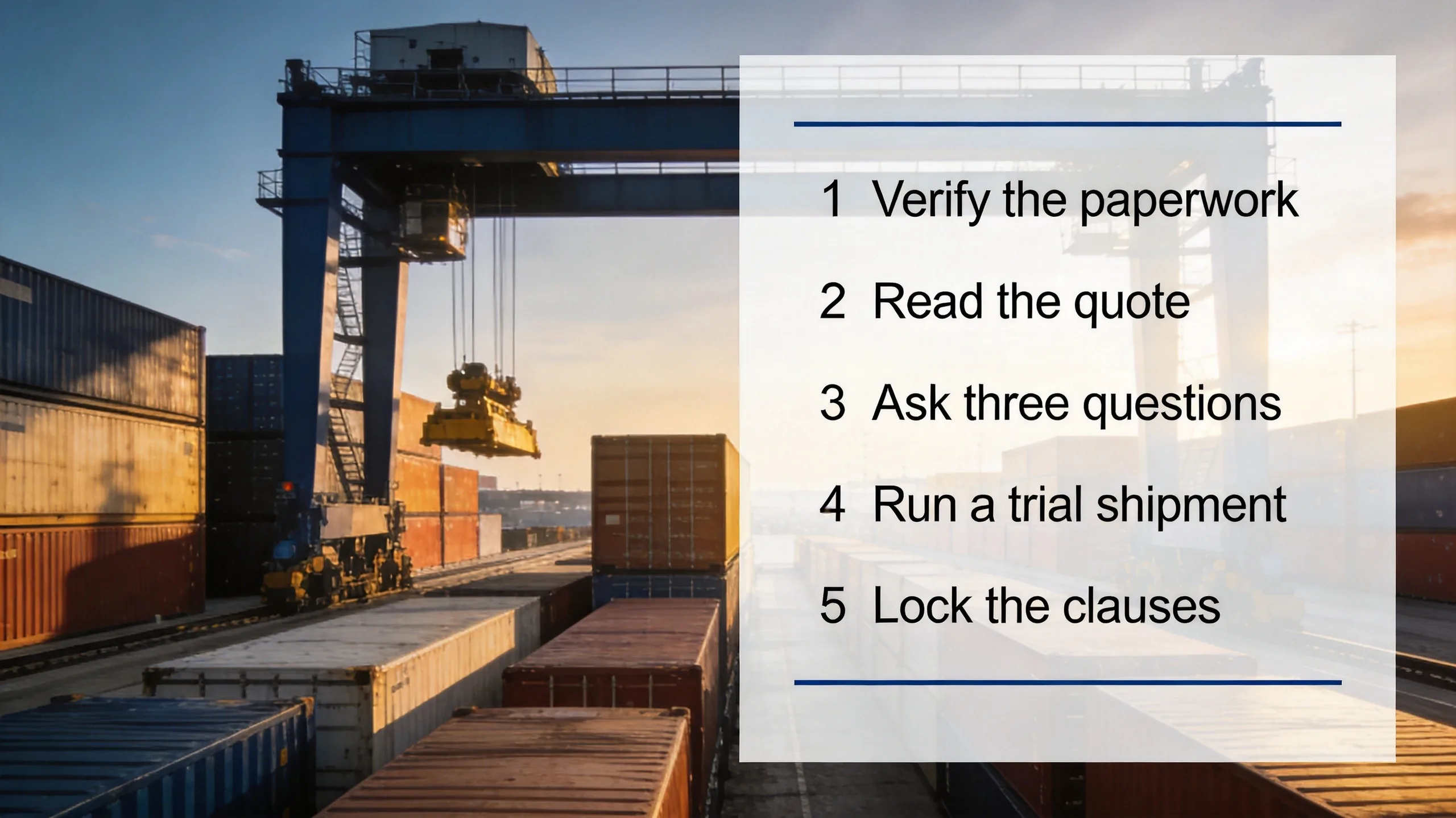
This guide is not a list of qualities to admire. It is a screening process you can run in about three weeks, with five steps, one trial shipment and a scorecard. If you want the conceptual background first — what a forwarder is, what it is not, and how the different types differ — start with our guide to what global freight forwarding actually is and come back here for the operating procedure.
You are buying a promise, not capacity
A forwarder does not own the ships. On a typical booking it is buying space from a carrier that bought it from someone else, then assembling the documentation chain around your cargo. What you are actually paying for comes down to three things:
- Space when space is scarce. Anyone can book a container in February. The test is the three weeks before Golden Week.
- Documents that are right the first time. A single mismatch between invoice, packing list, bill of lading and certificate of origin is enough to stop a container.
- Behaviour when something goes wrong. This is the part nobody quotes for, and it is the only part that matters on the day your cargo is held.
None of those three show up on a quotation. That is the whole problem, and it is why the screening has to be designed rather than felt.
First, pick the right type — the wrong category fails harder than the wrong company
Most buyers skip this step and go straight to comparing prices between companies that do fundamentally different jobs. A competent B2B forwarder running a competent B2B operation will still fail an Amazon FBA inbound, because appointment booking, pallet configuration and Amazon’s rejection rules are a separate discipline.
| Type | What they actually sell | Right for | Do not expect |
|---|---|---|---|
| LCL consolidator | Their own container space and their own consolidation warehouse | Multi-supplier cargo, sub-container volumes, weekly sailings | FCL rate competitiveness, project cargo |
| NVOCC / FCL booking house | Contracted carrier space under their own bill of lading | Stable FCL volume, port-to-port | Door delivery, customs brokerage at destination |
| FBA specialist | First-leg freight plus clearance plus delivery appointment | Amazon sellers shipping to FBA warehouses | B2B bulk, letter of credit shipments |
| Traditional B2B forwarder | Documentation, export declaration, destination agent network | Bulk orders, LC terms, industrial cargo | Small parcels, D2C replenishment |
| Express / e-commerce agent | Carrier discounts and last-mile delivery | Samples, small D2C batches | Heavy cargo, anything needing a customs broker |
Decide which row you are in before you ask for a single quote. Then compare only within that row.
Step 1 — Screen the paperwork, and check it at the source
Every forwarder will send you a PDF folder of certificates. The screening is not reading them, it is verifying them somewhere other than the company’s own website.
- Business licence. The registered scope must cover international freight forwarding or NVOCC business. Ask for the unified social credit code and check it on the national enterprise credit system.
- Freight forwarding filing. Chinese forwarders file with the commerce authorities. The filing record is a public lookup, not a certificate the company prints.
- NVOCC filing. If they issue their own bill of lading rather than acting as an agent, they need to be filed for non-vessel-operating common carrier business with the transport authorities. If they cannot issue their own B/L, they are a broker — which is fine, as long as you know it.
- US-bound cargo: FMC status. A forwarder or NVOCC handling US trade must hold a Federal Maritime Commission licence or registration, backed by proof of financial responsibility — USD 50,000 for an ocean freight forwarder, USD 75,000 for a licensed NVOCC, USD 150,000 for a registered non-US NVOCC. The FMC publishes the list; check the legal name, not the trade name.
- AEO certification. China Customs AEO status is a real signal of documentation discipline. Advanced certified enterprises clear faster and are audited less. It is not a marketing badge.
- Insurance, two separate policies. Carrier liability insurance protects the forwarder. Cargo insurance protects your goods. A forwarder that cannot explain the difference does not understand claims.
- Network memberships. FIATA, WCA and similar bodies mean the company has paid a fee and passed a light check. Treat them as a plus, never as a qualification.
If any of the first five cannot be produced, stop. Price is not a useful conversation after that point.
Step 2 — Read the quote like an operator, not a buyer
A quotation is a diagnostic tool. What matters is not the total, it is whether the total can be decomposed. A forwarder that cannot break its price into named line items either does not know its own cost structure or is holding something back — and both are the same problem for you.
| Line item | Why it must be separate | What goes wrong when it is bundled |
|---|---|---|
| Ocean freight | It moves weekly with the market | Locked into a rate that quietly includes a margin buffer |
| Origin charges | THC, documentation, export declaration, seal, VGM | Absorbed into freight, then re-charged as “extras” |
| Destination charges | The single largest source of invoice shock | Arrives as a bill you cannot refuse after the cargo has sailed |
| Fuel and peak season surcharges | BAF and PSS have defined trigger conditions | Applied at the forwarder’s discretion with no stated threshold |
| Chargeable weight basis | CBM, revenue ton, or volumetric divisor | Your 3.2 CBM becomes 4 CBM and nobody explains why |
| Duty and VAT handling | Who advances the money, at what rate, settled when | Cash-flow surprise at destination and interest on top |
| Free time and detention | Free days at destination and the rate after they run out | The most expensive number in the whole quote is the one left out |
| Insurance | Rate, coverage basis, declared value | Goods move uninsured and everyone assumes otherwise |
| Payment and release terms | When you pay, when documents are released | Telex release withheld over an unrelated dispute |
The test is simple: ask for the destination side in writing, before you book. A forwarder that answers “we will tell you when the goods arrive” has told you exactly what the arrival will feel like. Our breakdown of every fee in China freight forwarding covers what each of these lines should look like.
Step 3 — Three questions that separate a desk from an operator
Ask these verbatim. The content of the answers matters less than how quickly they arrive and whether they come with evidence.
“Send me the destination invoice from your last shipment of this product category.” An operator has it and sends it, redacted if necessary. A reseller does not have it, because the transaction happened between two other companies.
“My container gets flagged for inspection at destination. Walk me through what happens, in order, and tell me who contacts me at each step.” You are listening for named steps and named responsibilities. Answers that stay at the level of “we will handle it for you” mean nobody has thought about it.
“Which line in this quote is most likely to change, and why?” This is the honesty test. A forwarder who immediately names two or three items and explains the trigger is telling you the truth about a business where nothing is fixed. A forwarder who says the quote is firm is either new or managing you.
Step 4 — Run one trial shipment you can actually measure
Do not scale on a promise and do not run the trial on your easiest cargo. The trial exists to produce evidence, so design it to fail visibly if the operation is weak.
- One shipment, not one container. Use LCL or a single FCL — enough to be real, small enough to absorb.
- Off-peak. Book it in a normal month. You are testing routine competence, not crisis performance.
- Representative cargo. Your main product category, with the documentation complexity you actually have. A trial with sample goods proves nothing.
- Two suppliers if possible. It tests consolidation and it tests whether they can keep two sets of documents straight.
| Metric | How to record it | Pass line |
|---|---|---|
| Booking confirmation time | Hours from your instruction to written space confirmation | Under 24 hours in a normal market |
| Document turnaround | Hours from your document submission to draft B/L | Under 48 hours, no rework requested |
| Pre-cutoff confirmation | Whether you were told the cut-off proactively | Told, not asked |
| Sailing to B/L issuance | Days from vessel departure to final bill of lading | Under 5 working days |
| Arrival to available | Days from vessel arrival to cargo releasable | Within the destination’s normal clearance window |
| Invoice variance | Final invoice divided by quoted total | Under 5%, with every new item pre-notified |
The last row is the one that decides the relationship. A 3% variance on a clean shipment is normal. A 20% variance made up of items you never saw is a business model, and it will scale with your volume. If you want to know what a well-run timeline looks like end to end, our step-by-step forwarding timeline sets the benchmarks.
Step 5 — Lock five clauses before you scale
Verbal commitments do not survive a bad month. These five clauses are the ones that decide who pays when something breaks.
| Clause | What to write | Why it matters |
|---|---|---|
| Liability cap | State the carrier’s limit and require your own cargo insurance on top | Statutory limits are far below cargo value: under China’s Maritime Code the cap is 666.67 units of account per package or 2 units per kilo, whichever is higher. A USD 6,000 pallet weighing 500 kg recovers roughly USD 1,300 at that cap. |
| Detention and demurrage | Who caused the delay, and how it is evidenced | These charges are attributable, but only if someone kept timestamps |
| Change notification | New charges need written approval before they are incurred | Turns an argument after the fact into a decision before it |
| Document release | Release on payment of the shipment’s own charges only | Prevents your cargo being used as security for an unrelated balance |
| Claims window | Notice period, response period, escalation path | Most claims die from missed deadlines, not from weak evidence |
Red flags that end the conversation
| Signal | What it usually means |
|---|---|
| Quote well below the market and refuses to itemise | The gap is recovered at destination, where you have no leverage |
| Only a personal messaging account, no company bank account | No legal entity in the transaction, so no claim |
| Bill of lading issuer differs from the contracting party | You have no contractual relationship with the party carrying your cargo |
| “All-in, taxes included” without asking for your HS code | Nobody has calculated the duty, so somebody will be surprised |
| Destination charges deferred to “after arrival” | The number is either unknown or unwelcome |
| Guaranteed space in peak season | Carriers do not guarantee space to forwarders; only allocation history shows it |
| Problems answered verbally, never in writing | No record, no liability, no claim |
| Refuses to show a previous invoice for similar cargo | There is no previous shipment of similar cargo |
What “reliable” means for your business model
The same forwarder can be excellent for one shipper and wrong for another. Screen against your own model, not against a generic checklist.
| Your model | Screen hardest on | Acceptable weakness |
|---|---|---|
| Amazon FBA | Appointment booking rate, pallet and labelling compliance, rejection handling | Higher unit cost, if appointments actually get booked |
| D2C brand | Replenishment frequency, last-mile handover, tracking data quality | No project cargo capability |
| B2B bulk / LC terms | Document accuracy, on-board B/L timing, bank presentation experience | Slow response outside office hours |
| Multi-supplier consolidation | Own warehouse, receiving discipline, per-supplier document separation | Not the cheapest on single-supplier FCL |
If you are consolidating from several factories, the warehouse is the operation — read how a consolidation warehouse should be run before you judge the freight rate.
FAQ
Is a cheap forwarder always a bad one?
No. A consolidator with its own container space can genuinely be cheaper on LCL than a forwarder reselling the same space, because there is one less margin in the chain. The problem is never the low price, it is a low price that cannot be explained line by line.
Are larger forwarders more reliable?
They are more stable, which is not the same thing. Large companies rarely disappear, but your account may be handled by a junior who changes every quarter, and escalation paths can be slow. Small operators can be excellent on service and fragile on capacity. Screen the specific team, not the logo.
How many forwarders should I work with?
Two is usually right for a growing shipper: a primary and a qualified backup you have already run a trial with. One leaves you exposed when capacity tightens. Five splits your volume so thin that nobody prioritises you, and none of them learns your cargo.
How long does the screening take?
Paperwork can be verified in two or three days. The trial shipment takes one full cycle, so realistically three to six weeks depending on the lane. That is faster than recovering from a bad annual contract.
What if the forwarder’s own insurance covers my goods?
It usually does not, or not at a level that matters. Carrier and forwarder liability is capped by convention and by contract, and the caps are low. Buy cargo insurance in your own name, with your company as the beneficiary, and check whether the coverage is all-risks or a named-perils basis.
Should I sign an annual contract?
Sign a rate agreement, not a volume commitment, until you have run at least two clean shipments. Annual commitments are how shippers end up locked into a service level they have not tested.
Getting it right the first time
The forwarders worth keeping are not the ones with the best presentation. They are the ones whose quote can be taken apart, whose documents are right the first time, and who answer with a plan rather than an apology when a container gets held.
We run consolidation, FBA prep and forwarding out of China for sellers shipping to the US, Europe and the Middle East — and we are comfortable being screened. Ask us for a decomposed quote on your actual cargo and judge us on the same five steps. Our quote request form takes about two minutes.
Two more reads before you decide: the mistakes that break forwarder relationships, and a shorter checklist for identifying a reliable agent.