
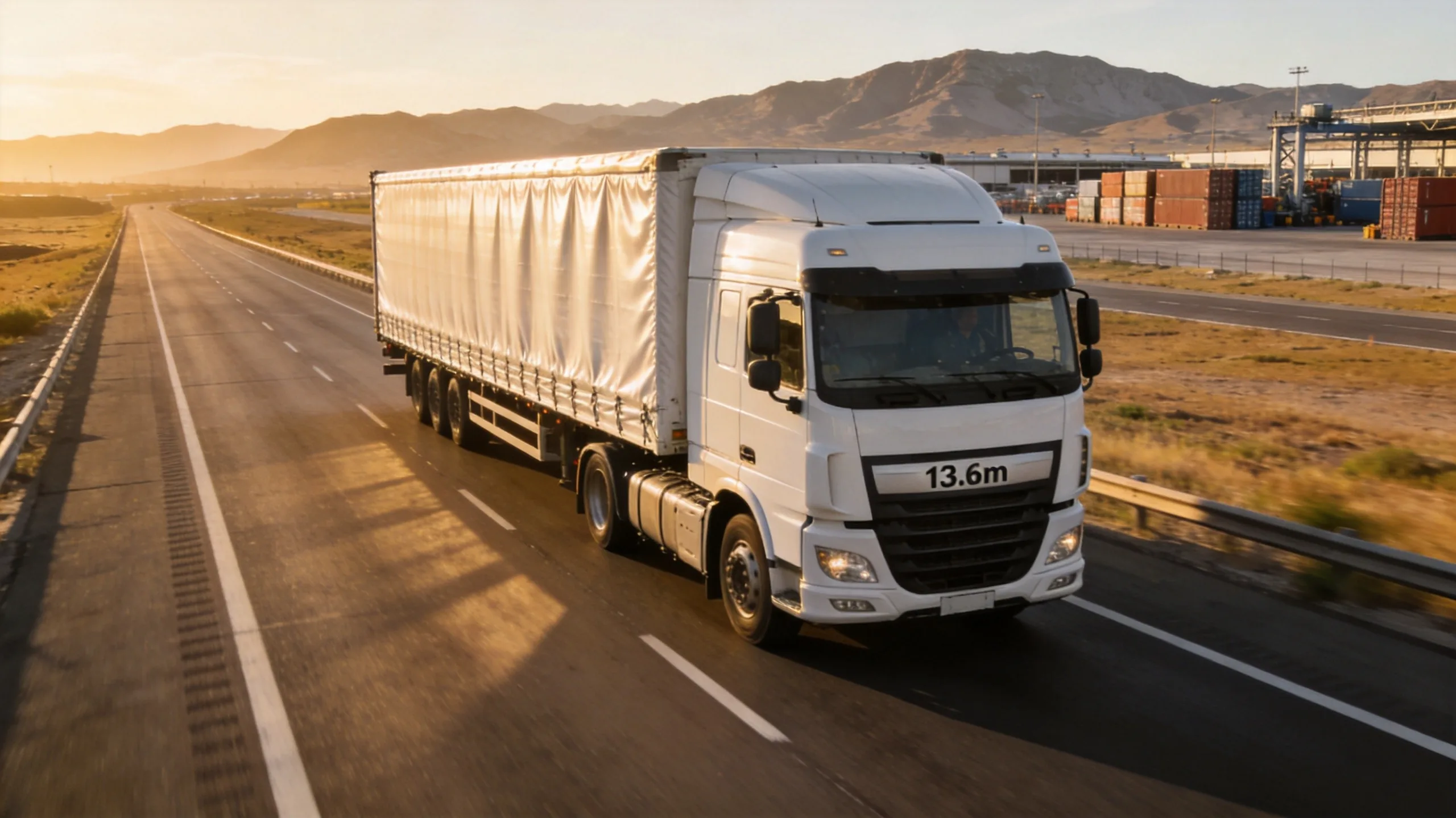
TIR trucking moves a sealed trailer from a Chinese warehouse to a European consignee in 12–18 days without re-inspecting the cargo at each border, at roughly 25% of the cost of air freight. China’s customs authority formalised the operating rules in Announcement No. 2 of 5 January 2026, effective 15 January 2026, which brought bonded cargo and cross-border e-commerce shipments into the TIR system for the first time.
Most China–Europe shippers still think in three modes: sea, rail, air. TIR is the fourth, and it has quietly become the only one that can hold a 12-day door-to-door schedule into Germany without paying air freight rates. In the first four months of 2026, departures from the Henan international road transport hub alone rose 60.31% year on year, with freight volume up 28.3% (Henan Daily, 1 June 2026).
This guide covers what TIR actually is, what China changed in January 2026, which of the two overland routes to pick, what a truck costs, and where TIR shipments fail — written from the perspective of a China warehouse that loads them.
What is TIR trucking and how does the TIR carnet work?
TIR is a United Nations customs transit system built on the 1975 TIR Convention: one carnet, one guarantee, one customs seal, valid across 78 contracting parties. Border customs officers check the seal and the carnet rather than opening the trailer, so cargo is inspected at origin and destination only.
The mechanism is what buys the time. Under a normal transit movement, a trailer crossing Kazakhstan, Russia and Belarus would face a customs declaration and often a physical inspection at each frontier — three to five days of pure dwell time on a China–Poland run. Under TIR, each of those frontiers is a seal check measured in hours.
Three components make it work:
- The carnet is the single customs document that replaces national transit declarations. It is issued per vehicle per trip and discharged at destination.
- The guarantee chain is a pooled financial guarantee, administered through the national guaranteeing association, that covers the customs duties at risk in every country the truck passes through. The importer does not post a separate bond in each transit country.
- The approved vehicle must be sealed and, in China, hold a Road Vehicle Approval Certificate for the Carriage of Goods under Customs Seal unless it is a container-carrying tractor-and-semi-trailer combination or an oversized-load vehicle.
One practical detail that surprises first-time buyers: on a Europe-bound run the trailer normally keeps its seal all the way, but the tractor unit is often swapped at the EU frontier. Non-EU carriers cannot perform intra-EU haulage, so an EU-registered tractor picks up the sealed trailer for the final leg. Nothing is opened, and the transit guarantee continues.
What changed for TIR in China in 2026?
China customs published Announcement No. 2 on 5 January 2026, effective 15 January 2026, extending TIR to bonded cargo and cross-border e-commerce and fixing exactly how each shipment must be declared in the Single Window. Six customs districts — Hangzhou, Qingdao, Zhengzhou, Shenzhen, Yinchuan and Urumqi — started the pilot on the effective date.
The announcement is technical, but four of its clauses change what a seller can actually do:
- Bonded cargo can move under TIR. Goods stored in a comprehensive bonded zone can leave under a “first-line integrated entry/exit” release note, with “TIR-” plus the carnet number written in the remarks field. Import cargo can enter the zone, stay bonded and defer duty.
- Cross-border e-commerce can move under TIR. Shipments declared under 9710 and 9810 use the standard declaration modules; shipments declared by inventory list use the cross-border e-commerce export module with the TIR application number in the vessel-name field and “TIR inland departure” in the remarks.
- Declarations are filed once. The TIR application number goes into the transport-tool field and the carnet number into the voyage field, so origin customs, exit-port customs, every transit country’s frontier customs and destination customs read the same record.
- The vehicle certificate has a clear validity rule. A certificate that is valid on the day the movement starts stays valid for the whole movement, even if it expires mid-route.
The scale behind those rules is now material. China had 272 TIR certificate-holding enterprises as of January 2026, customs supervised more than 3,800 TIR movements in 2025 — up 1.1 times year on year — and more than 70 international road transport routes are operating, covering Central Asia, West Asia and Europe (CCTV News, 16 January 2026).
TIR vs rail vs sea vs air: which mode wins on which shipment?
TIR wins when transit time matters more than unit cost but air freight is too expensive: typically 300–3,000 kg of finished goods that must reach a European warehouse inside three weeks. Sea is still the cheapest per unit above about 8 CBM, and rail beats TIR on cost for full containers.
| Mode | Door-to-door transit | Indicative cost band | Practical minimum | Best fit | Main risk |
|---|---|---|---|---|---|
| TIR truck | 12–18 days to Germany | About 25% of air freight (CCTV, 16 Jan 2026) | 1 pallet, shared trailer | Restock gaps, launch stock, oversize units | Border queueing at Khorgos; route politics |
| China–Europe rail | 12–20 days; Xi’an–Duisburg fastest 12 days (China Railway, 30 Apr 2026) | Lower per CBM than TIR above 15 CBM | 1 x 40HQ, or LCL consolidation | Full containers of stable-selling SKUs | Gauge changes at the China–Kazakhstan border |
| Sea freight | 28–40 days port to port | Lowest per CBM | 1 CBM LCL | High-volume, low-urgency cargo | Rate volatility, port congestion, demurrage |
| Air freight | 3–7 days | Highest | 45 kg chargeable | Fast-moving, high-value, low-weight | Dimensional weight penalties |
Transit times are door-to-door including consolidation at a China warehouse. Cost bands are ECW quote ranges for November 2026 and move with fuel, border queues and seasonal surcharges.
The single most useful benchmark in that table: TIR costs roughly a quarter of air freight and runs about twice as fast as rail on the same lane (CCTV News, 16 January 2026). For a seller restocking a European 3PL between container cycles, that is the whole business case.
Which route should a China–Europe TIR truck take?
Two corridors are operating in 2026: the northern route through Kazakhstan, Russia, Belarus and Poland at 12–15 days, and the Trans-Caspian route through Kazakhstan, Azerbaijan, Georgia and Türkiye at 15–18 days. The northern route is faster; the Trans-Caspian route avoids Russia entirely.
| Corridor | Countries crossed | Transit | Strengths | Constraints |
|---|---|---|---|---|
| Northern (via Russia, Belarus) | Kazakhstan → Russia → Belarus → Poland | 12–15 days | Shortest distance, most departures, lowest cost | Sanctions exposure; some insurers exclude Russia transit |
| Trans-Caspian | Kazakhstan → Azerbaijan → Georgia → Türkiye | 15–18 days | No Russia transit, works for sanctioned-sensitive buyers | Caspian ferry capacity, extra handling, higher cost |
| Trans-Caspian & Black Sea multi-leg | Kazakhstan → Caspian → Azerbaijan → Georgia → Black Sea | About 35 days, roughly 13,000 km | Reaches Ukraine, Romania, Bulgaria directly | Multi-modal handoffs, weather risk at sea legs |
Transit times are the range quoted by Chinese road transport operators in 2026. Commercial quotes vary because border queueing and ferry capacity on the Caspian drive most of the spread.
Route choice is usually decided by the buyer, not the carrier. If the consignee’s bank or insurer will not accept a movement that transits Russia, the 3–5 extra days on the Trans-Caspian corridor are simply the cost of doing business. If not, the northern corridor is cheaper and better served.
What does a TIR truck from China to Europe cost?
A full 13.6 m trailer from Shenzhen or Yiwu to a German 3PL typically prices at USD 14,000–22,000 in the 2026 market, or roughly USD 3.5–5.5 per kg for a part-load. The spread comes from route, season and how much of the trailer you actually fill.
| Cost line | Share of total | What drives it | How to reduce it |
|---|---|---|---|
| Line haul (China to EU border) | 55–65% | Distance, fuel, driver hours, route | Load from a warehouse close to the departure hub |
| Carnet and guarantee fees | 3–5% | Number of transit countries, cargo value | Fewer transit countries on the northern corridor |
| Border and transit handling | 8–12% | Queue length at Khorgos or Alashankou | Book off-peak; avoid the pre-Chinese New Year surge |
| Cargo insurance | 1–3% | Declared value, mode, route | Declare accurately; Russia-transit exclusions raise the rate |
| Origin handling and consolidation | 6–10% | Number of suppliers, labelling, pallet build | Consolidate suppliers into one warehouse before loading |
| EU delivery and unloading | 10–15% | Postcode, tail-lift, appointment windows | Deliver to a 3PL dock, not a retail address |
Cost structure for a shared TIR trailer from South China to Germany, November 2026 ECW quotes. Part-load pricing is per chargeable kg on the greater of actual or volumetric weight.
Two structural savings are usually missed. First, consolidating several suppliers into one China warehouse before loading turns three part-loads into one trailer — the mechanism is covered in our multi-supplier consolidation guide. Second, volumetric weight: a trailer fills by cube long before it reaches its weight limit, so carton dimensions set the price as much as the goods do.
Which products should move by TIR instead of rail or sea?
TIR suits high-value, time-sensitive, moderate-volume cargo: consumer electronics accessories, apparel restocks, beauty and personal care, small appliances, and anything oversize that will not fit a standard pallet footprint. It does not suit bulk commodities, low-margin heavy goods or anything with a shelf life longer than the transit.
| Product profile | Value density | TIR fit | Reason |
|---|---|---|---|
| Consumer electronics, phone accessories | USD 30–150/kg | Strong | Air-cost premium is a small share of retail price |
| Apparel and footwear restocks | USD 15–60/kg | Strong | Seasonal markdown risk outweighs freight premium |
| Cosmetics and personal care | USD 20–80/kg | Strong | Fast replenishment cycles, small cartons |
| Furniture, oversize home goods | USD 3–10/kg | Situational | Wins only when sea lead time would break a launch date |
| Building materials, raw materials | Below USD 2/kg | Poor | Sea or rail is structurally cheaper |
| Lithium battery products | Varies | Conditional | Needs dangerous-goods documentation and carrier acceptance first |
Fit is judged on value density (declared value per kg) and urgency. A product below roughly USD 8 per kg rarely justifies the premium over sea.
One compliance filter applies before any of this: general cargo and sensitive goods follow different carrier rules. If your product is in the sensitive category, read how carriers classify general versus sensitive goods before requesting a rate.
What documents does a TIR shipment need?
A TIR shipment needs the carnet, the Road Vehicle Approval Certificate, a commercial invoice and packing list, the export declaration filed through the Single Window TIR module, and a certificate of origin where the destination tariff requires one. The carnet must be discharged at destination or the guarantee stays open.
- TIR carnet — issued per vehicle per trip; the number must match the declaration exactly.
- Road Vehicle Approval Certificate — not required for container-carrying tractor-and-semi-trailer combinations or oversized-load vehicles.
- Commercial invoice and packing list — must reconcile to the declaration line by line; weight and carton count discrepancies are the most common cause of a hold.
- Export declaration — filed through the integrated TIR declaration module, with the TIR application number in the transport-tool field.
- Certificate of origin — needed where the EU or UK preferential rate depends on it.
- Insurance certificate — check whether the policy excludes Russia transit before the truck departs.
The declaration detail is where shipments actually break, not the truck. Our documentary customs declaration guide covers the field-level errors that trigger holds, and duty-deferred versus duty-paid (DDP) explains who is legally the importer when the trailer arrives.
How do you book TIR capacity from a China warehouse?
Booking TIR capacity takes four steps: confirm the route and departure hub, consolidate and label the cargo in a China warehouse, file the declaration with the correct TIR fields, and lock the carnet before the truck is sealed. Departures are weekly on the main lanes, not daily.
- Confirm the corridor. Decide northern versus Trans-Caspian with the consignee’s bank and insurer, not with the carrier. This single choice sets the transit date.
- Consolidate and label. Bring all supplier cargo into one warehouse, verify carton counts, apply shipping marks and build the pallet plan. A trailer that leaves half-empty still pays for the whole trailer.
- File the declaration. Use the Single Window TIR module, put the TIR application number in the transport-tool field and the carnet number in the voyage field.
- Lock the carnet and seal. The carnet is issued per vehicle per trip; once the trailer is sealed the document set is frozen. Changes after sealing mean unloading and re-declaring.
- Track to discharge. The guarantee stays open until the carnet is discharged at destination. Get the discharge confirmation in writing, not just a delivery note.
For the operational detail on vehicle types, axle loads and loading plans, see the China truck freight guide. If you are still comparing modes at the corridor level, the China–Europe and UK mode comparison puts sea, rail, truck and air side by side.
What goes wrong on TIR shipments?
The four recurring failures are border queueing at Khorgos and Alashankou, carnet numbers that do not match the declaration, insurance policies that silently exclude Russia transit, and cargo that arrives without a booked EU delivery slot. All four are preventable before the truck leaves China.
- Border queueing. Khorgos and Alashankou queue for days during the pre-Chinese New Year peak and around Kazakh holidays. Build a 3–5 day buffer into any launch-critical shipment.
- Carnet and declaration mismatch. The carnet number, TIR application number and declaration must agree character for character. A typo is a full stop at the frontier, not a phone call.
- Insurance exclusions. Many cargo policies exclude transit through Russia and Belarus. If the goods are high value, the exclusion can cost more than the freight saved.
- No EU delivery appointment. A sealed trailer arriving at a German 3PL without a booked dock slot accrues standing time that nobody quoted for.
- Undischarged carnet. If the carnet is not discharged, the guarantee stays open and blocks future movements. Always collect the discharge confirmation.
Frequently asked questions
Is TIR trucking faster than the China–Europe rail service?
Yes on door-to-door for part-loads. TIR runs 12–18 days from a China warehouse to a European 3PL, while block trains take 12–20 days plus consolidation and rail-yard handling at both ends. TIR costs roughly a quarter of air freight and runs about twice as fast as rail (CCTV News, 16 January 2026).
How much cargo do I need to book a TIR truck?
One pallet is enough on a shared trailer, and a full 13.6 m trailer holds about 25–26 standard pallets or 65–75 CBM. Part-loads price per chargeable kg, so a two-pallet shipment is a normal booking rather than a special case.
Does TIR trucking avoid US tariffs?
No. TIR is a customs transit system for the route, not a duty exemption. Duty is still assessed at the destination on the declared value and HS code, and the EU applies its own duty and VAT regardless of how the goods arrive.
Can TIR cargo transit Russia in 2026?
Yes, the northern corridor through Russia and Belarus is operating at 12–15 days. The constraint is commercial rather than legal: some banks, buyers and cargo insurers exclude Russia transit, which pushes those shipments onto the 15–18 day Trans-Caspian route instead.
Is TIR suitable for Amazon FBA shipments to Europe?
It is suitable when the FBA inbound window is tight. TIR delivers to a European 3PL or directly to a fulfilment centre in 12–18 days, but the trailer must meet the same labelling, carton-mark and appointment requirements as any other FBA inbound.
What is the difference between TIR and a normal truck to Europe?
A normal truck re-declares and often transloads at each frontier; a TIR truck keeps one carnet, one guarantee and one seal from origin to destination. That is why TIR holds a 12-day schedule across four or five countries while ordinary road transit does not.
Who is liable if the TIR cargo is damaged in transit?
The carrier is liable under the CMR convention that governs international road carriage, subject to its weight-based limits, and the TIR guarantee covers customs duties rather than cargo damage. Separate cargo insurance is required to recover the full commercial value.
Get a TIR quote on your actual shipment
TIR pricing depends on cube, corridor and departure week, so a rate without your carton dimensions is a guess. Easy China Warehouse consolidates supplier cargo in Shenzhen, Guangzhou and Yiwu, builds the load plan, and books TIR, rail, sea or air against the same shipment — so you can see the real cost gap rather than a generic table.
Send your product list, carton dimensions and destination postcode through the request a quote form, or read the freight forwarding service overview for the full mode mix. Sellers comparing TIR against sea and air for the first time usually start with how to choose a cross-border logistics method and the China to Europe shipping guide.